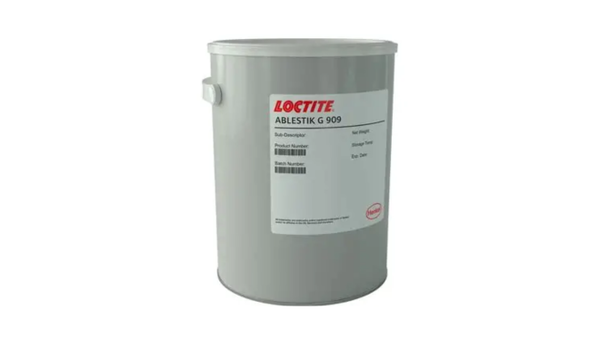
ABLESTIK G909
Harmonization Code : 3506.91.90.99 | Prepared glues and other prepared adhesives, not elsewhere specified or included; products suitable for use as glues or adhesives, put up for retail sale as glues or adhesives, not exceeding a net weight of 1 kg ; Adhesives based on polymers of headings 3901 to 3913 or on rubber; Other ; Other
Main features
- High-Strength Structural Bonding
- Thixotropic Non-Sag Placement
- 90-Minute 100 deg C Cure
Product Description
LOCTITE ABLESTIK G 909 is a gray, one-component, heat-cure epoxy adhesive for high-strength structural bonding, particularly between dissimilar substrates exposed to a broad operating-temperature range. Its thixotropic, non-sag paste form supports controlled application, including on inclined surfaces. Documented substrates include copper, aluminum, fiberglass-reinforced plastics, and oily steel. The adhesive operates from -40 to 150 degC and offers multiple heat-cure schedules, including 90 minutes at 100 degC, 30 minutes at 120 degC, or 20 minutes at 150 degC.
Key Features
- One-component heat-cure epoxy adhesive
- Thixotropic, non-sag gray paste
- Designed for high-strength structural bonding of dissimilar substrates
- Documented for copper, aluminum, fiberglass-reinforced plastics, and oily steel
- Operating-temperature range of -40 to 150 degC
- Typical aluminum tensile lap shear strength of 40 N/mm2 at 25 degC
Applications / Suitable for
- Structural bonding of dissimilar substrates
- Assemblies exposed to broad operating temperatures
- Bonding copper, aluminum, fiberglass-reinforced plastics, and oily steel
- Applications requiring non-sag adhesive placement
TDS, SDS & Technical Documents
Technical Specifications
General Properties
Thermal Properties
Additional Information
One-Component Structural Epoxy Adhesive
LOCTITE ABLESTIK G 909
LOCTITE ABLESTIK G 909 is a gray, one-component, heat-cure epoxy adhesive designed for high-strength structural bonding, especially between dissimilar substrates. Its thixotropic, non-sag paste form supports controlled placement, while the documented -40 to 150 degC operating range supports assemblies exposed to varied service temperatures.
As-Supplied Material
As-Supplied Properties
The one-component format eliminates resin-to-hardener measuring and mixing. The typical values below describe the uncured gray paste and its controlled-flow behavior.
Typical uncured value.
Typical processing characteristic.
Typical result supporting non-sag application.
| Property | Typical value | State / context |
|---|---|---|
| Technology | Epoxy | One-component, heat-cure adhesive |
| Appearance | Gray paste | As supplied |
| Specific gravity | 1.15 | Uncured material |
| Press flow | 65 seconds | Typical value |
| Sag resistance | 12.7 mm | Typical value |
| Shelf life | 4.5 months | 0 to 4 degC, from date of manufacture |
Application and Heat Cure
Processing and Cure
Completely clean the bonding surfaces to remove contamination such as oxide layers, dust, moisture, salt, and oils that may reduce adhesion or contribute to corrosion. Apply the adhesive to the surfaces, assemble the parts, and maintain the contact needed for the selected joint. In most documented applications, contact pressure is sufficient.
Cure times begin after the adhesive reaches the stated cure temperature and do not include equipment or assembly ramp-up time.
Storage and Handling
Store the unopened product in a dry location at the stated optimal temperature of 4 degC. The typical shelf life is 4.5 months when stored at 0 to 4 degC from the date of manufacture. Storage above or below 4 degC may adversely affect product properties. Keep the container closed, prevent contamination, and do not return removed material to the original container.
Final Bonded State
Cured Properties
These typical laboratory values apply to the stated substrates, temperatures, and test configurations. They should not be treated as guaranteed specifications or universal strength values for every substrate, surface preparation, joint geometry, or service condition.
| Property | Typical result | Test context |
|---|---|---|
| Hardness | 78 Shore D | Measured at 25 degC |
| Hardness | 35 Shore D | Measured at 120 degC |
| Tensile lap shear strength | 40 N/mm2 (5,800 psi) | Aluminum, tested at 25 degC |
| Tensile lap shear strength | 20.3 N/mm2 (2,950 psi) | Aluminum, tested at 100 degC |
| Tensile lap shear strength | 32.4 N/mm2 (4,700 psi) | Steel, tested at 25 degC |
| T-peel strength | 5.25 N/mm (30 lb/in) | Aluminum, ISO 11339 |
| Operating-temperature range | -40 to 150 degC | Documented operating range; property retention is condition-dependent |
Documented Bonding Scope
Substrates and Applications
Dissimilar-Substrate Bonding
Designed for structural bonding where the joined materials differ and the assembly requires a heat-cured epoxy bondline.
Metal and Composite Surfaces
Documented surfaces include copper, aluminum, fiberglass-reinforced plastics, and oily steel. Bond performance remains specific to preparation, substrate grade, and joint configuration.
Non-Sag Placement
The thixotropic paste format supports controlled application where resistance to flow or sag is important during assembly and heat cure.
Technical Support for LOCTITE ABLESTIK G 909
Discuss substrate preparation, bondline design, adhesive application, cure profiling, post-cure selection, and joint-performance testing with Krayden. Application trials should confirm adhesion and mechanical performance for the intended materials, geometry, thermal exposure, and manufacturing process.
Contact Krayden Technical Support