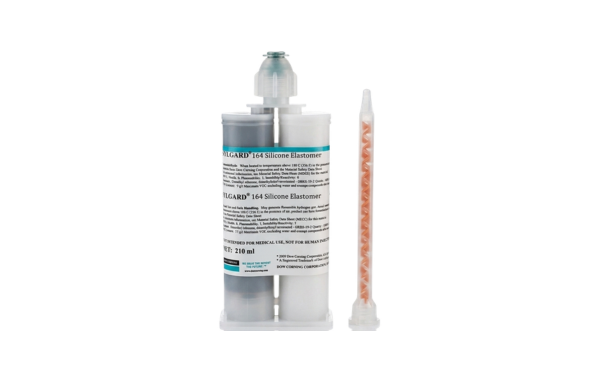
SYLGARD™ 164 Silicone Elastomer Kit
Harmonization Code : 3910.00.00.90 | Silicones in Primary Forms; Others
Main features
- Flowability for Different Processes
- Fast Room-Temperature Encapsulation Cure
- UL 94 V-0 Classification
Product Description
SYLGARD™ 164 Silicone Elastomer Kit is a two-part, gray silicone encapsulant developed for general potting and protection of electrical and electronic assemblies. The components mix at a 1:1 ratio and cure to a flexible elastomer using a rapid room-temperature or heat-accelerated cure process. Good flowability supports dispensing and filling around components, while moderate thermal conductivity and electrical insulation properties address functional encapsulation requirements. The cured material has a typical thermal conductivity of 0.64 W/m·K, a typical dielectric strength of 19 kV/mm, and a UL 94 V-0 flammability classification.
Key features
- 1:1 two-part mixing: Supports automated metered mixing and dispensing for electronic potting processes.
- Versatile cure processing: Provides rapid room-temperature curing with heat acceleration available for shorter processing cycles.
- Functional encapsulation properties: Provides typical thermal conductivity of 0.64 W/m·K, typical dielectric strength of 19 kV/mm, and a UL 94 V-0 classification.
Applications / Suitable for
- Potting of power supplies, amplifiers, and high-voltage resistor packs
- Encapsulation of connectors, sensors, and relays
- Protection of industrial controls and transformers
TDS, SDS & Technical Documents
Technical Specifications
General Properties
Thermal Properties
Electrical Properties
Additional Information
Potting and encapsulation
SYLGARD 164 Silicone Elastomer
SYLGARD 164 Silicone Elastomer is a two-part, 1:1 mix, gray general-purpose silicone encapsulant for electrical and electronics potting. It combines good flowability, a typical 14-minute working time at 25 deg C, rapid room-temperature or heat-accelerated cure, moderate thermal conductivity, and UL 94 V-0 flammability classification. After cure, it forms a flexible elastomer for protecting PCB system assemblies and electrical components.
As supplied
Two-component material and process-window data
Values are typical and are not intended for use in preparing specifications. Part A and Part B data are shown separately.
Part A viscosity
8925 cP
Typical viscosity of the uncured base component.
Part B viscosity
9175 cP
Typical viscosity of the uncured catalyst component.
Mix ratio
1:1
Two-part liquid kit with equal-part mixing.
Working time
14 min
Typical snap time at 25 deg C.
| Property | Value | Unit | Condition / state |
|---|---|---|---|
| Viscosity, Part A / Base | 8925 | cP | Uncured component |
| Viscosity, Part B / Catalyst | 9175 | cP | Uncured component |
| Specific gravity, Part A / Base | 1.58 | - | Uncured component |
| Specific gravity, Part B / Catalyst | 1.57 | - | Uncured component |
| Working time | 14 | min | 25 deg C, snap time |
| Cure time | 0.6 | h | 25 deg C |
| Shelf life | 15 | months | At 25 deg C |
Processing
Mix, de-air, dispense, and cure with controlled timing
SYLGARD 164 is designed for automated metered mixing and dispensing. Thoroughly mix the two liquid components at the stated 1:1 ratio, minimize air entrapment, and dispense into the container or assembly where the material will cure. Vacuum dispensing is preferred when practical for assemblies with many small voids; otherwise the filled unit can be evacuated after dispensing.
01 Surface preparation
Clean and prime where adhesion is required
For applications requiring adhesion, apply the appropriate silicone primer as a very thin, uniform coating, wipe after application, and allow it to air dry thoroughly before applying the elastomer.
02 Mix and de-air
Thoroughly combine Parts A and B
Mix the two liquid components thoroughly. Cure begins during mixing and is first seen as a gradual viscosity increase followed by gelation and conversion to a solid elastomer.
03 Dispense
Minimize entrapped air
Pour or dispense the thoroughly mixed material directly into the container or assembly. Use vacuum dispensing when practical, especially where the potted component contains many small voids.
04 Cure
Room-temperature or accelerated heat cure
The material may be cured at 25 deg C or heat accelerated for faster cure. Typical cure time is 0.6 h at 25 deg C. No post cure is required after completion of the cure schedule.
Storage and handling
Protect the two-part kit from moisture
Typical shelf life is 15 months at 25 deg C. For best results, store the silicone encapsulant at or below 25 deg C, prevent moisture contact, keep containers tightly closed, and minimize headspace. Partially filled containers should be purged with dry air or another dry gas such as nitrogen before resealing. Read the applicable Safety Data Sheets and container labels before handling.
Final properties
Flexible cured elastomer with electrical and thermal insulation data
The values below are typical properties and are not specifications. Dielectric data describe material-level test results and should not be interpreted as an assembly working-voltage rating.
Hardness
61 Shore A
Typical cured durometer.
Dielectric strength
19 kV/mm
475 V/mil in the alternate source unit.
Thermal conductivity
0.64 W/(m K)
Typical bulk material value.
Flammability
UL 94 V-0
UL flammability classification.
| Property | Value | Unit | Method / condition |
|---|---|---|---|
| Durometer | 61 | Shore A | Cured elastomer |
| Dielectric strength | 475 / 19 | V/mil / kV/mm | Typical material property |
| Dielectric constant | 3.33 | - | 100 Hz |
| Dielectric constant | 3.28 | - | 100 kHz |
| Volume resistivity | 1.1 E + 13 | ohm*cm | Typical material property |
| Dissipation factor | 0.0078 | - | 100 Hz |
| Dissipation factor | 0.0009 | - | 100 kHz |
| Thermal conductivity | 0.64 | W/(m K) | Typical bulk material property |
| Linear CTE | 225 | ppm/deg C | TMA |
| UL flammability classification | 94 V-0 | - | UL classification |
| UL RTI rating | 150 | deg C | UL RTI rating |
Technical guidance
Application controls that matter during evaluation
These controls are important during process development and qualification. Application-specific verification remains necessary, especially for temperature extremes and materials that may inhibit cure.
Useful temperature guidance
For most uses, these silicone encapsulants are intended to operate from -45 to 200 deg C for long periods. Performance near the low- and high-temperature extremes is application dependent and should be verified on the actual part or assembly. Thermal cycling to -55 deg C may be possible but also requires verification.
Cure-inhibition screening
Potential inhibitors for addition-cure silicone systems include organotin and other organometallic compounds, sulfur-containing materials, unsaturated hydrocarbon plasticizers, and some solder flux residues. When compatibility is uncertain, run a small-scale test and check the interface for liquid or uncured material.
Selective repair access
Dow silicone encapsulants can be selectively removed depending on the removal method and technique. For repotting, remove the unwanted elastomer mechanically, roughen exposed cured surfaces, clean and dry them, then apply additional encapsulant. Silicone prime coats are not recommended for adhering the material to itself.
Applications
General electronics potting applications
SYLGARD 164 is suitable for general potting of the electrical and electronic component types listed below.
Power and high-voltage assemblies
Power supplies, transformers, and resistor packs
Suitable for general potting of power supplies, transformers, and high-voltage resistor packs where a flexible silicone encapsulant is being evaluated.
Control and switching components
Industrial controls and relays
Suitable for general potting of industrial controls and relays, with the final process and application conditions verified on the target assembly.
Signal and interface components
Connectors, sensors, and amplifiers
Suitable for general potting of connectors, sensors, and amplifiers where the 1:1 processing format, cure window, and cured electrical properties fit the assembly requirements.
Technical support
Evaluate SYLGARD 164 for your potting process
Krayden can help review SYLGARD 164 against your assembly geometry, required electrical and thermal properties, surface-preparation needs, dispensing approach, cure window, and service-temperature conditions. Share the target component, cavity configuration, substrates, process constraints, and qualification requirements to support a focused material and process evaluation.