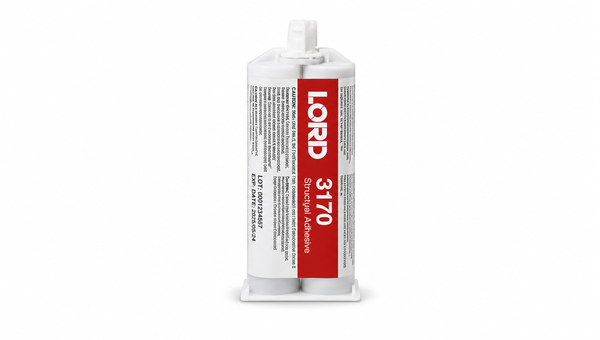
LORD 3170
Harmonization Code : 8529.90 | Parts solely or principally used for TV, radio, and transmission
Main features
- Bond Strength Down to -253 deg C
- Low-Outgassing Aerospace Epoxy
- Equal-Volume Room-Temperature Cure
Product Description
LORD® 3170-A/3170-B Epoxy Adhesive is an equal-mix, two-component epoxy structural adhesive designed to bond metals, glass, reinforced plastics, ceramics and foam materials in cryogenic applications. The system provides high bond strength at very low temperatures and minimal outgassing for aerospace use. It can be cured at room temperature or with elevated heat for faster processing and improved mechanical properties and bond strength.
Key Features
- Cryogenic performance with documented tensile shear and butt tensile strength at temperatures down to -423°F (-253°C).
- Minimal outgassing with 1.47% total mass loss and 0.02% collected volatile condensable materials per ASTM E595-84.
- Equal-volume mixing of 3170-A resin and 3170-B hardener for straightforward manual or cartridge application.
- Room-temperature or accelerated curing with improved mechanical properties and bond strength following a 1-hour postbake at 212°F (100°C).
Applications / Suitable for
- Cryogenic structural bonding
- Aerospace assemblies requiring minimal outgassing
- Bonding metals, glass, reinforced plastics and ceramics
- Bonding foam insulation materials to solid substrates
TDS, SDS & Technical Documents
Technical Specifications
General Properties
Physical Properties
Thermal Properties
Additional Information
As-Supplied / Before-Processing Properties
Typical component and mixed properties. Values are typical and are not intended for specification purposes.
| Property | 3170-A Resin | 3170-B Hardener | Mixed | Method / Condition |
|---|---|---|---|---|
| Appearance | Milky white liquid | Amber liquid | Light amber paste | Typical |
| Viscosity | 55,000 cP | 130,000 cP | — | At 77°F (25°C) |
| Density | 9.55 lb/gal (1138 kg/m³) |
8.1 lb/gal (971 kg/m³) |
— | Typical |
| Flash Point | >201°F (>93°C) |
>201°F (>93°C) |
— | Setaflash closed cup |
| Mix Ratio | 1 part | 1 part | 1:1 | Resin to hardener, by volume |
| Solids Content | — | — | 100% | Mixed adhesive |
| Working Time | — | — | 2 hours | At 75°F (24°C) |
| Time to Handling Strength | — | — | 24 hours | Typical |
| Recommended Film Thickness | — | — | 0.002–0.003 in (0.05–0.07 mm) |
General use |
| Recommended Film Thickness | — | — | 0.01 in (0.25 mm) |
Foam insulation bonded to solid substrates |
| Shelf Life | 2 years | 2 years | — | From date of manufacture; store at 60–80°F (16–27°C) in original, unopened containers |
After-Processing / Final-State Properties
Typical cured properties. Unless otherwise stated, cured-property and bond-performance data were generated after 24 hours at room temperature followed by 1 hour at 149°F (65°C) under 10 psi pressure.
| Property | Value | Unit | Method / Condition |
|---|---|---|---|
| Cure to Full Strength | 4 | days | At 75°F (24°C) |
| Recommended Postbake | 1 hour | — | At 212°F (100°C); improves mechanical properties and bond strength |
| Cured Appearance | Yellow to honey-colored | — | Typical |
| Hardness | 70 | Shore D | Typical |
| Coefficient of Linear Thermal Expansion | 3 × 10⁻⁵ | in/in/°F | From -423°F to 32°F (-253°C to 0°C) |
| Total Mass Loss | 1.47 | % | ASTM E595-84 |
| Collected Volatile Condensable Materials | 0.02 | % | ASTM E595-84 |
| Tensile Shear Strength | 2500 (17.2) |
psi (MPa) |
At -423°F (-253°C); 7075-T6 bare aluminum alloy, tested per MIL-A-5090D |
| Tensile Shear Strength | 3000 (20.7) |
psi (MPa) |
At room temperature; 7075-T6 bare aluminum alloy, tested per MIL-A-5090D |
| Butt Tensile Strength | 5800 (40.0) |
psi (MPa) |
At -423°F (-253°C); Federal Test Method Standard 175, Methods 1051 and 1051.1T |
| Lap Shear Strength after Humidity Exposure | 2500 (17.2) |
psi (MPa) |
At room temperature after 720 hours at 100% RH and 165°F (74°C) |
| Lap Shear Strength after Salt Spray Exposure | 2900 (20.0) |
psi (MPa) |
At room temperature; saturated salt spray exposure per MIL-A-005090C and Federal Test Standard 51 |