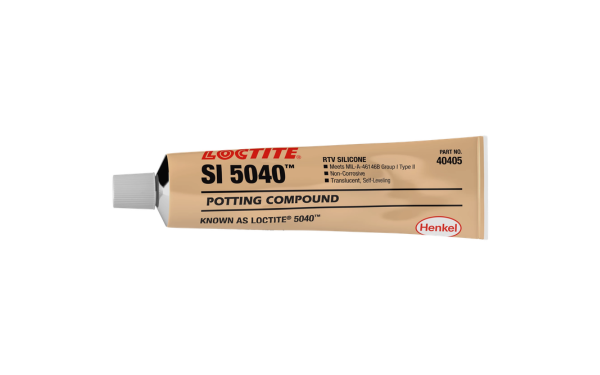
LOCTITE SI 5040
Harmonization Code : 3919.10.80 | Other self-adhesive plastic rolls not exceeding 20 cm wide.
Main features
- One-Component Sealing System
- Non-Corrosive Sealing Formulation
- Self-Leveling Flowable Placement
Product Description
LOCTITE® SI 5040™ is a one-component alkoxy silicone RTV sealant designed for potting, coating, and sealing automotive, electronic, military, and industrial components. The self-leveling, non-corrosive formulation provides uniform cavity filling while maintaining flexibility, shock absorption, and environmental durability. After curing, it forms a resilient silicone elastomer that resists moisture, ozone, weathering, and harsh service environments while maintaining performance at temperatures up to 200°C.
Key Features & Benefits
- One-component RTV alkoxy silicone system.
- Non-corrosive curing mechanism.
- Self-leveling for uniform cavity fill.
- Excellent moisture, ozone and weather resistance.
- Provides flexibility and shock absorption.
- Suitable for potting, coating and sealing applications.
- Tested to MIL-A-46146B requirements.
Recommended Applications
- Electronic component potting.
- Protective conformal coating.
- Industrial sealing applications.
- Automotive component protection.
- Military and environmental sealing systems.
TDS, SDS & Technical Documents
Technical Specifications
General Properties
Appearance
Translucent milky white viscous liquid Appearance at room temperature.
Specific Gravity
1.05 Specific gravity (SG) is the ratio of the density of a substance to the density of a reference substance; equivalently, it is the ratio of the mass of a substance to the mass of a reference substance for the same given volume.
For liquids, the reference substance is almost always water (1), while for gases, it is air (1.18) at room temperature. Specific gravity is unitless.
Physical Properties
Viscosity
85,000 mPa.s Viscosity is a measurement of a fluid’s resistance to flow.
Viscosity is commonly measured in centiPoise (cP). One cP is defined as
the viscosity of water and all other viscosities are derived from this base. MPa is another common unit with a 1:1 conversion to cP.
A product like honey would have a much higher viscosity -around 10,000 cPs-
compared to water. As a result, honey would flow much slower out of a tipped glass than
water would.
The viscosity of a material can be decreased with an increase in temperature in
order to better suit an application
Additional Information
Technical Properties
As-Supplied / Before-Processing Properties
| Property | Value | Unit | Condition |
|---|---|---|---|
| Technology | Silicone | — | RTV sealing and potting compound |
| Chemical Type | Alkoxy Silicone | — | Non-corrosive system |
| Appearance | Translucent Milky White Viscous Liquid | — | Uncured material |
| Specific Gravity | 1.05 | — | 25°C |
| Solids Content | ≥92 | % | Non-volatile content |
| Viscosity | 85,000 | mPa·s (cP) | Brookfield RVT, spindle 6, 2.5 rpm |
| Viscosity | 35,000 | mPa·s (cP) | Brookfield RVT, spindle 6, 20 rpm |
| Storage Requirement | 2 to 8 | °C | Recommended storage range |
Technical Properties
After-Processing / Final-State Properties
| Property | Value | Unit | Condition / Method |
|---|---|---|---|
| Maximum Service Temperature | 200 | °C | Typical operating limit |
| Shore Hardness | ≥15 | Shore A | ISO 868 |
| Elongation at Break | ≥150 | % | ISO 37 |
| Tensile Strength | ≥1.0 | N/mm² | ISO 37 |
| Tear Strength | 17.5 | N/mm | ISO 34-1 Die B |
| Water Absorption | 0.05 | % | 24 h @ 23°C |
| Dielectric Breakdown Strength | 16 | kV/mm | IEC 60243-1 |
| Volume Resistivity | 7 × 10¹⁶ | Ω·cm | IEC 60093 |
| Lap Shear Strength (Steel to Glass) | 1.8 | N/mm² | 1 week cure @ 23°C |
| Lap Shear Strength (Glass to Glass) | 1.7 | N/mm² | 1 week cure @ 23°C |