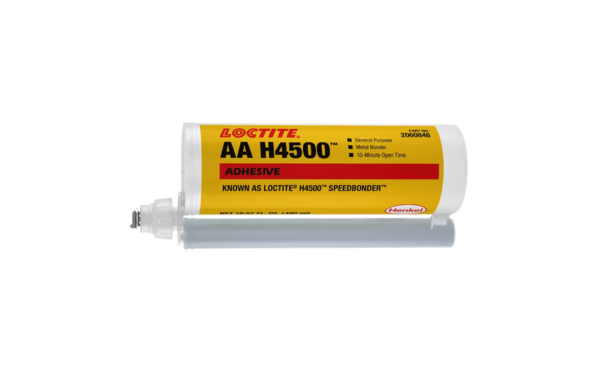
LOCTITE H4500
Harmonization Code : 3403.19 | Lubricating Preparations (With 70% or More Petroleum Oils) For Automotive and Other Uses
Main features
- 15-Minute Working Time
- High Impact and Peel Strength
- Primerless Structural Bonding
Product Description
LOCTITE® AA H4500™ is a two-component methacrylate structural adhesive designed to provide resilient, high-strength bonds across a wide variety of substrates including metals, plastics, composites, and coated surfaces. The adhesive cures at room temperature, offers excellent environmental durability, superior impact and peel strength, and tolerates off-ratio mixing. Its thixotropic, non-sag formulation can fill gaps up to 12.7 mm and does not require a primer for most applications.
Key Features & Benefits
- Two-component methacrylate structural adhesive.
- Excellent environmental resistance.
- Superior impact and peel strength.
- Excellent tolerance to off-ratio mixing.
- Primerless bonding on many substrates.
- Non-sag formulation fills gaps up to 12.7 mm.
- Non-corrosive cured adhesive system.
Recommended Applications
- Steel and stainless steel bonding.
- Aluminum assembly applications.
- Epoxy-coated metal structures.
- Sheet molding compound (SMC) assemblies.
- Engineering plastic and composite bonding.
TDS, SDS & Technical Documents
Technical Specifications
General Properties
Appearance
Gray Appearance at room temperature.
Specific Gravity
0.99/0.96 Specific gravity (SG) is the ratio of the density of a substance to the density of a reference substance; equivalently, it is the ratio of the mass of a substance to the mass of a reference substance for the same given volume.
For liquids, the reference substance is almost always water (1), while for gases, it is air (1.18) at room temperature. Specific gravity is unitless.
Physical Properties
Viscosity
14,900/9,200 mPa.s Viscosity is a measurement of a fluid’s resistance to flow.
Viscosity is commonly measured in centiPoise (cP). One cP is defined as
the viscosity of water and all other viscosities are derived from this base. MPa is another common unit with a 1:1 conversion to cP.
A product like honey would have a much higher viscosity -around 10,000 cPs-
compared to water. As a result, honey would flow much slower out of a tipped glass than
water would.
The viscosity of a material can be decreased with an increase in temperature in
order to better suit an application
Additional Information
Technical Properties
As-Supplied / Before-Processing Properties
| Property | Value | Unit | Condition |
|---|---|---|---|
| Technology | Methacrylate Adhesive | — | Two-component acrylic system |
| Appearance (Part A) | White | — | Resin |
| Appearance (Part B) | Black Viscous Liquid | — | Hardener |
| Appearance (Mixed) | Gray | — | Mixed adhesive |
| Mix Ratio | 10 : 1 | Part A : Part B | By volume |
| Specific Gravity (Part A) | 0.99 | — | 25°C |
| Specific Gravity (Part B) | 0.96 | — | 25°C |
| Viscosity (Part A) | 14,900 | mPa·s (cP) | 25°C |
| Viscosity (Part B) | 9,200 | mPa·s (cP) | 25°C |
| Working Time | 15 | minutes | 25°C |
| Fixture Time | 10 - 15 | minutes | ISO 4587, steel |
Technical Properties
After-Processing / Final-State Properties
| Property | Value | Unit | Condition / Method |
|---|---|---|---|
| Glass Transition Temperature (Tg) | 107 | °C | ISO 11359-2 |
| Shore Hardness | 73 | Shore D | ISO 868 |
| Elongation at Break | 11 | % | ISO 527-2 |
| Tensile Strength at Break | 19.5 | N/mm² | ISO 527-2 |
| Tensile Strength at Yield | 32 | N/mm² | ISO 527-2 |
| Tensile Modulus | 1,370 | N/mm² | ISO 527-2 |
| Lap Shear Strength (Stainless Steel) | ≥20.7 | N/mm² | 24 h @ 22°C |
| Lap Shear Strength (Aluminum) | 21 | N/mm² | 72 h @ 22°C |
| Impact Strength (Steel) | 12 | J | ISO 9653 |
| T-Peel Strength (Steel) | 10 | N/mm | ISO 11339 |