LOCTITE EA M-31
Harmonization Code : 3506.91.90.99 | Prepared glues and other prepared adhesives, not elsewhere specified or included; products suitable for use as glues or adhesives, put up for retail sale as glues or adhesives, not exceeding a net weight of 1 kg ; Adhesives based on polymers of headings 3901 to 3913 or on rubber; Other ; Other
Main features
- Ultra-Clear Bonding Material
- 30-Minute Working Window
- 19.7 kV/mm Dielectric Strength
Product Description
LOCTITE EA M-31CL is a two-part, room-temperature-curing epoxy adhesive formulated to produce an ultra-clear bondline for bonding, small potting, staking, and laminating. The resin and hardener mix at 2:1 by volume or 100:46 by weight and provide a 30-minute working life. The cured material combines minimal shrinkage with impact-resistant structural performance, electrical insulation, and resistance to a range of chemicals and solvents. It bonds glass, optical fibers, ceramics, metals, and many rigid plastics, supporting clarity-sensitive and multi-material assemblies.
Key features
- Ultra-clear mixed appearance: Clear colorless to slightly yellow components produce an ultra-clear mixed adhesive for clarity-sensitive bondlines.
- Controlled two-part mixing: Mix 2:1 by volume or 100:46 by weight, resin to hardener.
- 30-minute working life: Supports application and assembly before room-temperature cure; larger quantities or higher temperatures shorten the working time.
Applications / Suitable for
- Clear bonding and laminating of glass and optical fibers
- Bonding ceramics, metals, and many rigid plastics
- Small potting and staking where an ultra-clear insulating epoxy is required
TDS, SDS & Technical Documents
Technical Specifications
No specifications available.
Additional Information
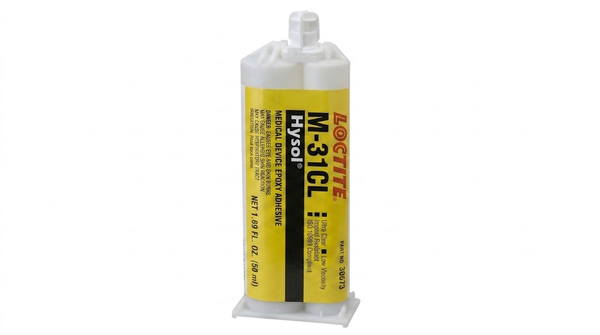
LOCTITE EA M-31CL
LOCTITE EA M-31CL is a two-part, low-viscosity epoxy adhesive that cures at room temperature to an ultra-clear bondline. It is designed for bonding, small potting, staking, and laminating applications involving glass, optical fibers, ceramics, metals, and many rigid plastics. Published data provide processing guidance plus mechanical, dielectric, substrate-specific bond strength, and environmental exposure results.
 LOCTITE EA M-31CL two-part epoxy adhesive.
As-supplied and mixed properties
Typical reference data. Component state, test temperature, viscosity method, and ratio basis are preserved; the values are not guaranteed product specifications.
| Property | Value | Unit | Method / condition |
|---|---|---|---|
| Resin appearance | Clear colorless to slightly yellow liquid | Not applicable | As supplied |
| Hardener appearance | Clear colorless to slightly yellow liquid | Not applicable | As supplied |
| Mixed appearance | Ultra clear | Not applicable | After mixing |
| Components | Two part | Resin and hardener | Room-temperature-curing epoxy system |
| Mix ratio by volume | 2:1 | Resin:hardener | Two-part system |
| Mix ratio by weight | 100:46 | Resin:hardener | Two-part system |
| Resin specific gravity | 1.1 | Not applicable | At 25 degrees C |
| Hardener specific gravity | 1.0 | Not applicable | At 25 degrees C |
| Mixed specific gravity | 1.07 | Not applicable | At 25 degrees C |
| Resin viscosity | 9,000 to 12,000 | mPa-s (cP) | Brookfield RVT, 25 degrees C, spindle 6, 20 rpm |
| Hardener viscosity | 1,500 to 9,000 | mPa-s (cP) | Brookfield RVT, 25 degrees C, spindle 5, 20 rpm |
| Working life | 30 | minutes | Typical; larger quantities or higher temperatures reduce the working time |
| Tack-free time | 160 | minutes | Low humidity |
| Gel time | 90 to 150 | seconds | At 100 degrees C |
Mixing, application, and cure
Prepare clean bonding surfaces, meter the resin and hardener at the stated ratio, mix thoroughly, apply within the working window, and hold the assembly under contact pressure while the adhesive cures. Dual cartridges may be used with a mixing nozzle, or the components may be hand mixed.
Recommended bonding sequence
Store unopened containers in a dry location at an optimal temperature of 8 to 21 degrees C. Storage below 8 degrees C or above 28 degrees C may adversely affect product properties. Keep containers closed, protect them from heat, ignition sources, direct sunlight, and moisture, and do not return removed material to the original container. Use adequate ventilation and appropriate protective gloves and eye or face protection, and review the current safety data for both components before use. Do not use the product in pure oxygen or oxygen-rich systems or select it as a sealant for chlorine or other strong oxidizing materials.
Cured material properties
Detailed cured-property data
Cured-material results are typical reference values. Test method, cure condition, and state are retained where supplied.
| Property | Value | Unit | Method / condition |
|---|---|---|---|
| Glass transition temperature | 70 | degrees C | ASTM E 228; cured at 25 degrees C except where noted |
| Elongation at break | 8 | % | ISO 527-2; cured at 25 degrees C except where noted |
| Tensile strength | 55.2 (8,000) | N/mm2 (psi) | ISO 527-2; cured at 25 degrees C except where noted |
| Shore hardness | 80 to 90 | Durometer D | ISO 868; cured 16 to 18 hours at 22 degrees C, then 2 hours at 65 degrees C |
| Dielectric breakdown strength | 19.7 | kV/mm | IEC 60243-1; cured material |
Bond strength by substrate
Typical laboratory results for the stated substrates, surface preparation, bondline, cure, and test method. Values are not universal joint-strength guarantees.
| Property | Value | Unit | Method / condition |
|---|---|---|---|
| Lap shear - aluminum, etched and abraded, 0.13 mm gap | At least 6.9 (at least 1,000) | N/mm2 (psi) | ISO 4587; cured 2 hours at 65 degrees C |
| Lap shear - steel, grit blasted | 21.4 (3,100) | N/mm2 (psi) | ISO 4587; cured 5 days at 22 degrees C |
| Lap shear - aluminum, etched and abraded, 0.1 to 0.2 mm gap | 29.4 (4,270) | N/mm2 (psi) | ISO 4587; cured 5 days at 22 degrees C |
| Lap shear - aluminum, anodized | 21.2 (3,070) | N/mm2 (psi) | ISO 4587; cured 5 days at 22 degrees C |
| Lap shear - stainless steel | 13.6 (1,970) | N/mm2 (psi) | ISO 4587; cured 5 days at 22 degrees C |
| Lap shear - polycarbonate | 13.4 (1,950) | N/mm2 (psi) | ISO 4587; cured 5 days at 22 degrees C |
| Lap shear - nylon | 2.4 (350) | N/mm2 (psi) | ISO 4587; cured 5 days at 22 degrees C |
| Lap shear - fir wood | 12.1 (1,750) | N/mm2 (psi) | ISO 4587; cured 5 days at 22 degrees C |
| Block shear - PVC | 7.0 (1,010) | N/mm2 (psi) | ISO 13445; cured 5 days at 22 degrees C |
| Block shear - ABS | 8.4 (1,220) | N/mm2 (psi) | ISO 13445; cured 5 days at 22 degrees C |
| Block shear - epoxy glass | 20.6 (2,980) | N/mm2 (psi) | ISO 13445; cured 5 days at 22 degrees C |
| Block shear - acrylic | 1.2 (180) | N/mm2 (psi) | ISO 13445; cured 5 days at 22 degrees C |
| Block shear - glass | 24.4 (3,540) | N/mm2 (psi) | ISO 13445; cured 5 days at 22 degrees C |
Chemical and environmental resistance
Percent of initial lap shear strength after exposure. Steel specimens were cured for 5 days at 22 degrees C, aged under the stated conditions, and tested at 22 degrees C.
| Environment | Exposure temperature | Strength after 500 hours | Strength after 1,000 hours |
|---|---|---|---|
| Air | 87 degrees C | 155% | 150% |
| Motor oil, 10W30 | 87 degrees C | 160% | 145% |
| Unleaded gasoline | 87 degrees C | 120% | 110% |
| Water/glycol, 50/50 | 87 degrees C | 145% | 140% |
| Salt fog | 22 degrees C | 70% | 85% |
| 95% relative humidity | 38 degrees C | 105% | 115% |
| Condensing humidity | 49 degrees C | 90% | 90% |
| Water | 22 degrees C | 100% | 90% |
| Acetone | 22 degrees C | 100% | 105% |
| Isopropanol | 22 degrees C | 120% | 120% |
These results apply to the tested steel lap-shear configuration and exposure conditions. They do not establish universal chemical compatibility or bonded-assembly durability.
Applications and use contexts
The product is documented for bonding, small potting, staking, and laminating where clarity and the cured epoxy's structural, mechanical, or electrical insulating properties are relevant. Application suitability should be confirmed with the actual substrates, surface preparation, bondline, cure, and service environment.


Evaluate LOCTITE EA M-31CL for your bonding process
Talk with Krayden about substrate preparation, mix and dispense options, bondline control, cure scheduling, and validation for your assembly. The technical team can help compare the published property data with your substrates, joint design, processing window, and operating environment.