LOCTITE EA 9696
Harmonization Code : 3506.10.00.00 | Prepared glues and other prepared adhesives, not elsewhere specified or included; products suitable for use as glues or adhesives, put up for retail sale as glues or adhesives, not exceeding a net weight of 1 kg
Main features
- High-Toughness Aerospace Bonding
- Broad Controlled Cure Window
- 2,000-Hour Environmental Conditioning
Product Description
LOCTITE EA 9696 is a modified epoxy film adhesive for aerospace structural bonding. It is designed for metal-to-metal and aluminum honeycomb assemblies requiring toughness and service temperatures to 250°F/121°C. The film can be cured for 60 to 90 minutes from 225 to 265°F/107 to 129°C, with pressure applied before heating and maintained through cooldown. Long shop exposure supports production handling after refrigerated storage, while published shear, peel, honeycomb and environmental-conditioning results provide application-specific evaluation data for the source-named .030NW and .060NW film configurations.
Key features
- Product form: Modified epoxy film adhesive supplied as a green solid film.
- Bonding scope: Documented for metal-to-metal and aluminum honeycomb bonding.
- Cure window: 60 to 90 minutes at 225 to 265°F/107 to 129°C.
- Assembly pressure: 25 to 50 psi/172 to 345 kPa is usually sufficient for proper part mating.
- Open assembly time: At least 60 days at 77°F/25°C or 30 days at 90°F/32°C after removal from cold storage.
- Defined service temperature: 250°F/121°C, based on retention of 1,000 psi/6.9 MPa by ASTM D1002.
Applications / Suitable for
- Metal-to-metal aerospace bonding.
- Aluminum honeycomb sandwich assemblies.
- Reticulated film use in sound-suppression assemblies.
TDS, SDS & Technical Documents
Technical Specifications
No specifications available.
Additional Information
LOCTITE EA 9696
LOCTITE EA 9696 is a modified epoxy film adhesive for aerospace metal-to-metal and aluminum honeycomb bonding. It combines a 225 to 265°F cure range, balanced flow, long room-temperature shop exposure and a defined service temperature of 250°F/121°C. Published shear, peel and honeycomb data cover multiple film configurations, cure profiles and environmental-conditioning histories.
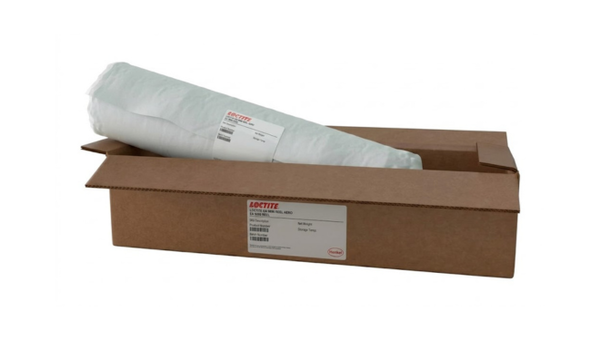
.png) LOCTITE EA 9696 modified epoxy film adhesive for aerospace structural bonding.
LOCTITE EA 9696 modified epoxy film adhesive for aerospace structural bonding.
As-supplied film properties
| Property | Value | Unit | Method / condition |
|---|---|---|---|
| Technology / product class | Modified epoxy film adhesive | N/A | As supplied; primary function is structural bonding. |
| Physical state | Solid film | N/A | Safety data for LOCTITE EA 9696 15UNS AERO. |
| Color | Green | N/A | Safety data for LOCTITE EA 9696 15UNS AERO. |
| Volatile content | <1 | % | Measured after 60 minutes at 250°F/121°C. |
| Adhesive circle flow, .030NW | 400 | % | Source-reported bulk resin property. |
| Adhesive circle flow, .060NW | 700 | % | Source-reported bulk resin property. |
| Adhesive circle flow, .085NW | 950 | % | Source-reported bulk resin property. |
| Estimated VOC content | <10 | g/L | SCAQMD Rule 1124; EPA Test Method 24/304-91, estimated. |
Application and cure
Keep the adhesive protected by its liner until final assembly, maintain clean prepared faying surfaces, apply pressure before heat-up and retain pressure through cooldown. Cure temperature, dwell, ramp rate and pressure must be controlled together because the published performance data are tied to specific process conditions.
Store at 0°F/-18°C or below for maximum storage life; the source reports a 12-month warranty life from shipment at that temperature. Keep the film sealed to prevent moisture contamination and allow condensed moisture to evaporate before opening. After removal from cold storage, open assembly time is at least 60 days at 77°F/25°C or 30 days at 90°F/32°C. For industrial use, follow the current label and safety documentation, use task-appropriate ventilation and protective equipment, and avoid heating film masses greater than 1 lb/0.454 kg except when curing the surfaces being bonded.
Cured material properties
| Property | Value | Unit | Method / condition |
|---|---|---|---|
| Cured density | 1.14 | g/mL | Bulk resin property. |
| Glass transition temperature, dry | 253 / 123 | °F / °C | DMTA, storage modulus E-prime curve. |
| Glass transition temperature, wet | 200 / 93 | °F / °C | DMTA after conditioning at 160°F/71°C and 98% relative humidity to moisture equilibrium. |
| Moisture uptake | <3 | % | After wet conditioning to moisture equilibrium. |
| Ultimate tensile strength at -65°F/-55°C | 11,070 / 76.3 | psi / MPa | ASTM D638; 0.125 in/3.18 mm castings. |
| Ultimate tensile strength at 77°F/25°C | 6,839 / 47.2 | psi / MPa | ASTM D638; 0.125 in/3.18 mm castings. |
| Ultimate tensile strength at 180°F/82°C | 3,841 / 26.5 | psi / MPa | ASTM D638; 0.125 in/3.18 mm castings. |
| Ultimate tensile strength at 220°F/104°C | 2,528 / 17.4 | psi / MPa | ASTM D638; 0.125 in/3.18 mm castings. |
| Ultimate tensile strength at 250°F/121°C | 982 / 6.8 | psi / MPa | ASTM D638; 0.125 in/3.18 mm castings. |
| Coefficient of thermal expansion, 50 to 90°C | 98.4 | µm/m°C | Specimens fabricated per ASTM E831-86. |
| Coefficient of thermal expansion, 170 to 210°C | 152.6 | µm/m°C | Specimens fabricated per ASTM E831-86. |
| Thermal conductivity | 5.10 × 10⁻⁴ | cal/(cm·s·°C) | Specimens fabricated per ASTM D2214-70. |
Bonding performance evidence
The source reports typical results for defined substrates, preparations, film configurations, cure cycles, conditioning histories and test temperatures. Use these data to compare documented conditions; they are not guaranteed specifications, universal joint strengths or design allowables.
Wide-area overlap shear was tested by ASTM D3165-73 on 2024-T3 bare aluminum treated by phosphoric acid anodizing and coated with a corrosion-inhibiting primer. The results show similar room-temperature strength for the documented .030NW and .060NW configurations after the 250°F cure, while the .030NW dataset also includes lower and higher cure-temperature profiles.
| Cure schedule | Test temperature | .030NW, MPa | .060NW, MPa |
|---|---|---|---|
| 250°F/121°C, 90 min, 45 psi | -67°F/-55°C | 31.8 | 29.5 |
| 250°F/121°C, 90 min, 45 psi | 77°F/25°C | 31.9 | 31.6 |
| 250°F/121°C, 90 min, 45 psi | 176°F/80°C | 24.5 | 23.9 |
| 250°F/121°C, 90 min, 45 psi | 250°F/121°C | 13.1 | 13.6 |
| 225°F/107°C, 90 min, 25 psi | 77°F/25°C | 30.7 | — |
| 225°F/107°C, 90 min, 25 psi | 250°F/121°C | 15.3 | — |
| 260°F/127°C, 90 min, 100 psi | 77°F/25°C | 31.5 | — |
| 260°F/127°C, 90 min, 100 psi | 250°F/121°C | 15.1 | — |
Tensile lap shear was tested by ASTM D1002 or EN 2243-1 on phosphoric-acid-anodized, corrosion-inhibiting-primed 2024-T3 AlClad. The vacuum cure used a 250°F/121°C dwell for 75 minutes under 22 in-Hg/75 kPa vacuum; the pressure cure used a 90-minute dwell at that temperature with 45 psi/310 kPa pressure.
| Conditioning | Test temperature | .030NW vacuum cure, MPa | .030NW pressure cure, MPa | .060NW pressure cure, MPa |
|---|---|---|---|---|
| None | -67°F/-55°C | 38.2 | 44.9 | 46.7 |
| None | 77°F/25°C | 34.8 | 38.4 | 42.9 |
| None | 176°F/80°C | 27.2 | 31.1 | 32.8 |
| None | 250°F/121°C | 17.3 | 15.5 | 13.3 |
| Dry heat at 176°F/80°C for 2,000 h | -67°F/-55°C | 38.3 | 44.8 | 46.2 |
| Dry heat at 176°F/80°C for 2,000 h | 77°F/25°C | 34.6 | 39.8 | 42.4 |
| Dry heat at 176°F/80°C for 2,000 h | 176°F/80°C | 28.0 | 29.6 | 32.7 |
| Hot/wet at 158°F/70°C and 95% RH for 2,000 h | 77°F/25°C | 32.5 | 36.8 | 38.8 |
| Hot/wet at 158°F/70°C and 95% RH for 2,000 h | 176°F/80°C | 21.1 | 22.1 | 19.9 |
| Hydraulic fluid, tri-n-butyl phosphate at 158°F/70°C for 2,000 h | 77°F/25°C | 32.4 | 32.9 | 31.3 |
| Hydraulic fluid, tri-n-butyl phosphate at 158°F/70°C for 2,000 h | 176°F/80°C | 26.2 | 25.4 | 24.3 |
| De-icing fluid at 104°F/40°C for 2,000 h | 77°F/25°C | 34.4 | 37.1 | 39.8 |
| De-icing fluid at 104°F/40°C for 2,000 h | 176°F/80°C | 26.6 | 27.7 | 28.4 |
| JP-8 fuel at 77°F/25°C for 2,000 h | 77°F/25°C | 34.4 | 38.9 | 42.5 |
| JP-8 fuel at 77°F/25°C for 2,000 h | 176°F/80°C | 27.8 | 29.9 | 32.0 |
Metal peel tests used prepared and primed 2024-T3 aluminum after a 250°F/121°C pressure cure. Honeycomb tests used treated and primed 2024-T3 AlClad faces with a 5052 aluminum honeycomb core after a 90-minute, 250°F/121°C cure at 45 psi/310 kPa.
| Test | Conditioning | Test temperature | .030NW result | .060NW result |
|---|---|---|---|---|
| T-peel, ASTM D1876 | None | 77°F/25°C | — | 42 lb/in / 187 N/25 mm |
| Climbing drum peel, ASTM D1781, metal-to-metal | None | 77°F/25°C | 116 in-lb/in / 516 mN/m | 142 in-lb/in / 632 mN/m |
| Floating roller peel, ASTM D3167 | None | 77°F/25°C | 75 lb/in / 334 N/25 mm | 71 lb/in / 316 N/25 mm |
| Floating roller peel, ASTM D3167 | None | 176°F/80°C | 72 lb/in / 320 N/25 mm | 87 lb/in / 387 N/25 mm |
| Honeycomb climbing drum peel, ASTM D1781 | None | -67°F/-55°C | — | 72 in-lb/3 in / 107 mN/m |
| Honeycomb climbing drum peel, ASTM D1781 | None | 77°F/25°C | — | 78 in-lb/3 in / 116 mN/m |
| Honeycomb climbing drum peel, ASTM D1781 | None | 176°F/80°C | — | 68 in-lb/3 in / 101 mN/m |
| Flatwise tension, ASTM C297 | None | -67°F/-55°C | — | 1,624 psi / 11.2 MPa |
| Flatwise tension, ASTM C297 | None | 77°F/25°C | — | 1,298 psi / 9.0 MPa |
| Flatwise tension, ASTM C297 | None | 176°F/80°C | — | 886 psi / 6.1 MPa |
| Flatwise tension, ASTM C297 | Dry heat at 176°F/80°C for 2,000 h | -67°F/-55°C | — | 1,616 psi / 11.1 MPa |
| Flatwise tension, ASTM C297 | Dry heat at 176°F/80°C for 2,000 h | 77°F/25°C | — | 1,316 psi / 9.1 MPa |
| Flatwise tension, ASTM C297 | Dry heat at 176°F/80°C for 2,000 h | 176°F/80°C | — | 830 psi / 5.7 MPa |
Applications and bonding contexts
LOCTITE EA 9696 is documented for aerospace metal and honeycomb bonding. The relevance of each use depends on the selected film configuration, substrate and surface preparation, joint geometry, pressure and cure cycle.


Evaluate LOCTITE EA 9696 with Krayden
Krayden can help review film configuration, substrate preparation, liner handling, cure temperature and pressure, honeycomb or metal joint geometry, and interpretation of the published shear, peel and environmental-conditioning data. Contact the team to discuss product selection, samples or an evaluation plan for your aerospace bonding process.