LOCTITE EA 9396C-2
Harmonization Code : 8529.90 | Parts solely or principally used for TV, radio, and transmission
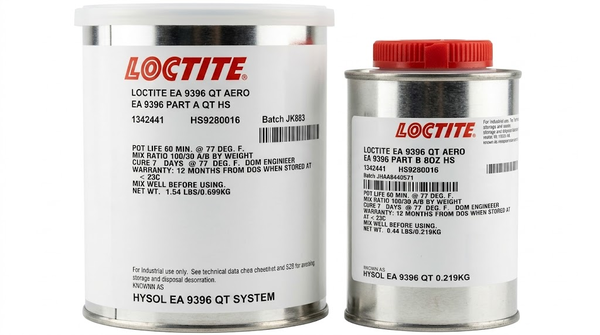
Main features
- Extended Processing Window
- 1-Hour Cure Cycle
- Non-MDA Curing and Application
Product Description
LOCTITE EA 9396C-2 AERO is a two-part, elevated-temperature-curing epoxy paste adhesive for structural bonding and neat lay-up resin use. The system combines a blue Part A with a purple Part B to form a violet mixed adhesive at a 100:36 weight ratio. It provides a 7-hour pot life for a 450 g mass at 25 degrees C and requires a minimum cure of 1 hour at 93 degrees C. On phosphoric-acid-anodized 2024-T3 aluminum, typical tensile lap shear strength is 31.7 MPa at 25 degrees C and 17.2 MPa at 177 degrees C after the stated cure.
Key features
- Extended pot life: 7 hours at 25 degrees C for a 450 g mixed mass, supporting a controlled working window.
- Temperature-dependent bond performance: Typical lap shear is 31.7 MPa at 25 degrees C and 17.2 MPa at 177 degrees C on the documented aluminum test configuration.
- Non-MDA curing system: Uses a non-aromatic amine curing agent and is identified for use as a neat lay-up resin.
Applications / Suitable for
- Neat lay-up resin use.
TDS, SDS & Technical Documents
Technical Specifications
No specifications available.
Additional Information
LOCTITE EA 9396C-2 AERO
LOCTITE EA 9396C-2 AERO is a two-part, elevated-temperature-curing epoxy paste adhesive with a low-viscosity formulation, a 7-hour pot life at 25 degrees C for a 450 g mass, and a non-aromatic amine curing agent. It is designed for structural bonding and is identified for use as a neat lay-up resin, with documented lap-shear performance on phosphoric-acid-anodized 2024-T3 aluminum.

As-supplied system properties
Typical component and mixed-system data. Preserve the stated component, temperature, method and product state when comparing or specifying process controls.
| Property | Value | Unit | Method / condition |
|---|---|---|---|
| Mix ratio | 100:36 | parts by weight | Part A to Part B. Volume measurement is not recommended for structural applications unless special precautions are used to assure the ratio. |
| Pot life | 7 | hours | Typical value for a 450 g mixed mass at 25 degrees C; ASTM D2471 in a water bath. |
| Color | Blue; purple; violet | - | Part A; Part B; mixed adhesive, respectively. |
| Viscosity, Part A | 70 | Pa s | At 25 degrees C; Brookfield HBT spindle 4 at 1.05 rad/s. |
| Viscosity, Part B | 0.04 | Pa s | At 25 degrees C; Brookfield LVF spindle 1 at 3.17 rad/s. |
| Density, Part A / Part B / mixed | 1.17 / 1.00 / 1.15 | g/mL | As supplied for Parts A and B; mixed state for the combined adhesive. |
| Shelf life, Part A and Part B | 1 | year | Reported for storage below 4 degrees C or below 25 degrees C. |
Mix, apply and cure under controlled conditions
Complete mixing, controlled batch size, prepared bonding surfaces and the specified heat cure are central to obtaining the documented performance. Keep the separate components near room temperature before mixing and maintain contact between the parts until the adhesive is set.
Shelf life is 1 year for both Part A and Part B when stored below 4 degrees C or below 25 degrees C. Material may be shipped at ambient conditions when it is placed into its intended storage upon receipt. Keep containers tightly closed in a cool, well-ventilated area. Do not heat unmixed Part A above 80 degrees C. For industrial use only; follow the current product label and safety data sheet, use adequate ventilation and wear appropriate personal protective equipment.
Cured bond performance
Typical tensile lap-shear results for the documented aluminum test configuration and cure. These values are not universal joint-strength specifications or design allowables.
| Property | Value | Unit | Method / condition |
|---|---|---|---|
| Tensile lap shear at 25 degrees C | 31.7 | MPa | Typical result, 4,600 psi. ASTM D1002; 2024-T3 bare aluminum, phosphoric acid anodized per ASTM D3933; cured 1 hour at 93 degrees C. |
| Tensile lap shear at 82 degrees C | 28.3 | MPa | Typical result, 4,100 psi. Same substrate preparation and cure. |
| Tensile lap shear at 121 degrees C | 22.1 | MPa | Typical result, 3,200 psi. Same substrate preparation and cure. |
| Tensile lap shear at 177 degrees C | 17.2 | MPa | Typical result, 2,500 psi. Same substrate preparation and cure. |
| Defined service temperature | Approximately 204 | degrees C | Defined as the temperature at which the adhesive retains 6.9 MPa, or 1,000 psi, using ASTM D1002. |
Performance evidence under temperature and moisture exposure
The following values are typical laboratory results for the stated cure and test conditions. They support comparative product evaluation and should not be treated as guaranteed design allowables.
Evaluate LOCTITE EA 9396C-2 AERO for your bonding process
Krayden can help review mix-ratio control, batch size, surface preparation, cure profile and temperature-dependent lap-shear data for your assembly. Share your substrates, joint design, process limits and service conditions to discuss product fit and next-step testing.