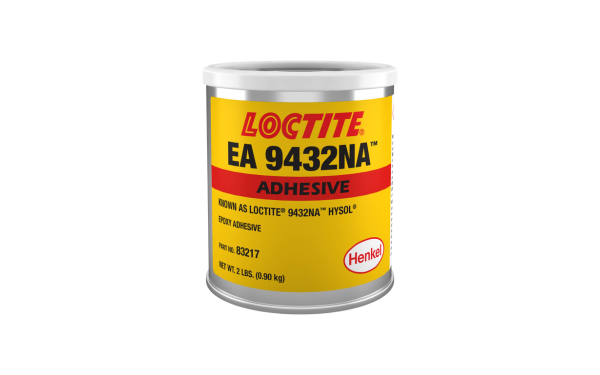
Loctite 9432 NA Epoxy Adhesive
Harmonization Code : 3506.91.90.99 | Prepared glues and other prepared adhesives, not elsewhere specified or included; products suitable for use as glues or adhesives, put up for retail sale as glues or adhesives, not exceeding a net weight of 1 kg ; Adhesives based on polymers of headings 3901 to 3913 or on rubber; Other ; Other
Main features
Product Description
LOCTITE® EA 9432NA (also known as Hysol® Adhesive 9432NA) is an aluminum-filled, thixotropic, one-component epoxy adhesive. It is formulated to provide excellent tensile shear strength over a wide temperature range and a high degree of impact resistance. Designed to cure at moderate temperatures, it maintains a long shelf life at room temperature and can easily be pumped and dispensed without sagging.
Product Key Features
- One-Component System - requires no mixing, simplifying application and handling.
- Thixotropic Non-Sag Paste - dispenses easily onto parts without slumping or sagging, even on vertical surfaces.
- Heat Cure - cures in 60 minutes at 120°C/250°F or achieves a faster cure in 30 minutes at 150°C/300°F.
- Robust Mechanical Profile - delivers a Shore D hardness of 90, a tensile strength of 50 MPa, 1.2% elongation, and a high modulus of 4690 MPa/ 680,000 psi.
- Excellent Resistances - provides excellent high-temperature performance and robust chemical resistance to various environmental exposures.
Applications
This adhesive fits applications requiring the bonding of a wide variety of substrates, offering exceptional tolerance to poorly prepared surfaces.
- Metal Bonding: Bonds effectively to etched or degreased aluminum, as well as cold rolled steel, even when the steel is oily or poorly prepared.
- Composite Assemblies: Suitable for bonding various composites, including fiberglass SMC and fiberglass vinyl ester laminates.
TDS, SDS & Technical Documents
Technical Specifications
General Properties
Mechanical Properties
Physical Properties
Additional Information
LOCTITE™ EA 9432NA
LOCTITE™ EA 9432NA (formerly known as Hysol® Adhesive 9432NA) is an aluminum-filled, thixotropic, one-component epoxy adhesive system engineered for high-performance structural bonding. Formulated to deliver outstanding tensile shear strength across a wide temperature range, this high-toughness compound provides exceptional impact resistance. It exhibits a unique tolerance for oily or poorly prepared surfaces and easily pumps or extrudes without slumping. Designed to cross-link rapidly under moderate bake temperatures, it ensures long shelf life stability and provides maximum reliability for demanding assembly workflows.
Typical engineering parameters only. Cross-linking requires a thermal activation cycle; property profiles depend on explicit baking temperatures.

Key Features
- Single-component formulation eliminates manual blending or volumetric tracking machinery, reducing error and scrap.
- Thixotropic non-sag paste consistency yields clean tracking and stands up to a maximum of 0.3" slump on vertical profiles at 150°C.
- Maintains high engineering shear strength (up to 26.2 MPa) across a wide range of hot and sub-zero environments.
- Surface preparation tolerant, delivering robust structural bonding onto oily metals and poorly cleaned substrates.
- Aluminum-filled epoxy grid develops superior hardness (90 Shore D) paired with maximum chemical and fluid immunity.
- Addition cross-linking proceeded evenly throughout deep sections without generating corrosive volatile by-products.
Processing Summary
Process Notes
- Ideally store material in cool, dry areas within unopened container vessels between 2° to 8°C (36° to 46°F).
- Refrigerated packages must be allowed to completely return to room temperature prior to starting application cycles.
- To avoid moisture contamination of the remaining stock, do not return any unused paste back into its original package.
- While surface-tolerant, best bond profiles require clean, dry faces cleared of thick scaling or loose particles.
- This epoxy grid system is not recommended for use in pure oxygen or oxygen-rich application systems.
- Do not select or configure this compound as an industrial sealant for liquid chlorine or other strong oxidizing agents.
- Uncured squeeze-out or overspray can be wiped from line components using common industrial solvents or citrus cleaners.
- Review your fluid supplier's documentation regarding safe handling, ventilation, and flashing risks for cleaning solvents.
- Once fully cross-linked via oven heating, this high-adhesion structural bond becomes extremely difficult to remove.
Engineering Data for LOCTITE™ EA 9432NA
Physical & Cured Mechanical Characteristics
| Physical Property | Typical Engineering Value | Test Method Standard Basis |
|---|---|---|
| Appearance / Color | Thixotropic paste / Gray | - |
| Viscosity | 150,000 - 300,000 cP | - |
| Specific Gravity | 1.38 | Measured at 77°F (25°C) |
| Density | 1.38 g/cm3 | Measured at 77°F (25°C) |
| Hardness | 90 Shore D | - |
| Tensile Strength | 50 MPa | ASTM D 638 |
| Tensile Modulus | 4690 MPa | ASTM D 638 |
| Ultimate Elongation | 1.2 % | ASTM D 638 |
Tensile Shear Strength over Varied Temperatures
Lap joints prepared with Etched Aluminum per ASTM D 1002, cured for 30 minutes at 150°C.1
| Testing Ambient Temperature (°F) | Typical Shear Value (MPa/psi) | Thermal Performance Level |
|---|---|---|
| 55°C (-67°F) | 24 / 3,500 | Cryogenic sub-zero hold stability |
| 25°C (77°F) | 26.2 / 3,800 | Standard room temperature baseline validation |
| 120°C (250°F) | 20.6 / 3,000 | Elevated continuous structural threshold |
| 150°C (300°F) | 16.5 / 2,400 | High temperature operating limit |
| 176.5°C (350°F ) | 2.75 / 400 | Extreme thermal limit values |
| 204.5°C (400°F) | 2.75 / 400 | Extreme thermal limit values |
Surface Tolerance & Substrate Bond Performance
Tested at 77°F per ASTM D 1002 protocols after a 30-minute cross-linking cycle at 150°C.
| Substrate Matrix Profile | Surface Preparation Protocol | Typical Shear Strength (Mpa/psi) |
|---|---|---|
| Degreased Aluminum | Standard chemical solvent clean | 24 / 3,500 |
| Cold Rolled Steel (Abraded) | Mechanical grit abrasion + wipe | 20.6 / 3,000 |
| Cold Rolled Steel (Degreased) | Solvent clean only (No abrasion) | 19.6 / 2,850 |
| Cold Rolled Steel (Oily) | Untreated mill oil residue surface | 18 / 2,600 |
| Fiberglass SMC (Vinyl Ester Laminate) | Standard compound surface clean | 6.9 / 1,000 |
| Fiberglass SMC (Owens Corning) | Standard clean matrix boundaries | 2.75 / 400 |
| Fiberglass SMC (Budd Co) | Standard clean matrix boundaries | 2.7 / 380 |

Where LOCTITE™ EA 9432NA Fits
(2).png)
- Cures reliably straight through protective mill oil residues.
- Maintains high structural shear thresholds (2,600 psi) on oily steel.
- Bypasses extensive chemical surface conditioning line pre-steps.
.png)
- Retains an impressive 2,400 psi shear capacity at 150°C (300°F).
- Resists physical degradation under prolonged hot air aging.
- Maintains stable mechanical strength under severe thermal shock cycles.
.png)
- Easily pumped and dispensed onto complex parts.
- Bead tracking stays completely immune to running risks.
- Limits gravity slump to a tight 0.3" maximum during heat bakes.
Standard Packaging & Technical Help
- Supplied ready-to-use inside standard industrial packaging and cartridge configurations.
- Single-component paste system requires no automated static or dynamic nozzle mixing valves.
- Original containers preserve long-term product shelf life stability under cold storage control.
- Designing optimized thermal profiles to enable accelerated 30-minute high-temperature bonding lines.
- Auditing custom part geometries and line setups to safely isolate and manage exothermic mass reactions.
- Configuring high-pressure pump feed parameters matching specified compound viscosities (150k-300k cP).
- Support for localized test coupon trials to verify target cohesive failure lap shear limits.
Tips and Troubleshooting
| Issue | Recommended Action |
|---|---|
| Material demonstrates excessive joint squeeze-out or gravity slump inside the heating oven |
|
| Material mass chars, bubbles, or alters substrate shape during high-temperature bakes |
|
| Adhesion tracking breakdown or low lap shear force values over difficult plastics |
|