LOCTITE 592
Harmonization Code : 3506.10.00.00 | Prepared glues and other prepared adhesives, not elsewhere specified or included; products suitable for use as glues or adhesives, put up for retail sale as glues or adhesives, not exceeding a net weight of 1 kg
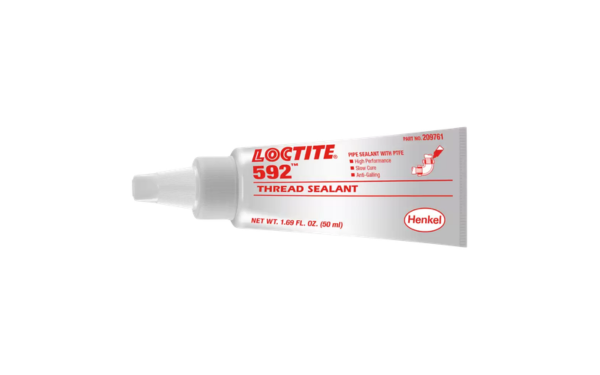
Main features
- High-Lubricity Thread Assembly
- Immediate Low-Pressure Seal
- Elevated Temperature Fluid Resistance
Product Description
LOCTITE® 592™ is a one-component, medium-strength anaerobic thread sealant designed for locking and sealing metal pipes and fittings. The high-viscosity dimethacrylate ester paste provides high lubricity to help prevent galling during assembly, supports immediate low-pressure sealing, and allows fittings to be repositioned shortly after assembly. After cure, it provides resistance to pressure, vibration, automotive fluids, fuels, water, and elevated temperatures in demanding industrial piping applications.
Key features
- High-lubricity thread sealing: Helps prevent galling on metal pipe threads and fittings during assembly.
- Immediate low-pressure seal: Properly tightened fittings can seal immediately while allowing short-term adjustment after assembly.
- Elevated-temperature fluid resistance: Supports industrial threaded connections exposed to oils, fuels, water, transmission fluid, and temperatures up to 204°C.
TDS, SDS & Technical Documents
Technical Specifications
General Properties
Physical Properties
Thermal Properties
Additional Information
As-supplied / before-processing properties
Typical properties of the uncured material; values are reference data rather than guaranteed product specifications.
| Property | Value | Unit | Method / condition |
|---|---|---|---|
| Technology | Acrylic | — | Uncured material |
| Chemical type | Dimethacrylate ester | — | Uncured material |
| Appearance | Thick, opaque, off-white paste | — | TDS description |
| Components | One component | — | No mixing required |
| Viscosity classification | High | — | Thread-sealing paste |
| Cure mechanism | Anaerobic | — | Cures when confined between metal surfaces without air |
| Strength classification | Medium | — | Thread-sealing application |
| Specific gravity | 1.21 | — | At 25°C; TDS value |
| Viscosity | 200,000–500,000 | mPa·s | Brookfield RVF, 25°C; spindle 7, 2 rpm |
| Density | 1.08 | g/cm³ | At 20°C; SDS value |
| Flash point | >100 | °C | SDS value |
| Auto-ignition temperature | >300 | °C | SDS value |
After-processing / final-state properties
Typical cured-material properties depend on cure time, substrate activity, temperature, joint geometry, surface condition, and test method.
| Property | Value | Unit | Method / condition |
|---|---|---|---|
| Coefficient of thermal expansion | 80 × 10−6 | K−1 | ISO 11359-2 |
| Thermal conductivity | 0.1 | W/(m·K) | ISO 8302 |
| Specific heat | 0.3 | kJ/(kg·K) | Typical cured-material property |
| Breakaway torque | ≥5.7 | N·m | ISO 10964; 3/8 × 24 grade-2 steel nuts and bolts; cured 24 hours at 93.3°C and tested at 22°C |
| Breakaway torque | ≥0.6 | N·m | ISO 10964; 3/8 × 24 grade-2 steel nuts and bolts; cured 72 hours at 22°C |
| Maximum typical application temperature | 204 | °C | Typical application limit stated in TDS |
| Motor-oil resistance | 85 | % initial strength | MIL-L-46152 motor oil at 87°C; 720-hour exposure |
| Unleaded-gasoline resistance | 90 | % initial strength | At 87°C; 720-hour exposure |
| Phosphate-ester resistance | 85 | % initial strength | At 87°C; 720-hour exposure |
| Distilled-water resistance | 90 | % initial strength | At 87°C; 720-hour exposure |
| Automatic-transmission-fluid resistance | 95 | % initial strength | At 87°C; 720-hour exposure |
| Brake-fluid resistance | 80 | % initial strength | At 87°C; 720-hour exposure |