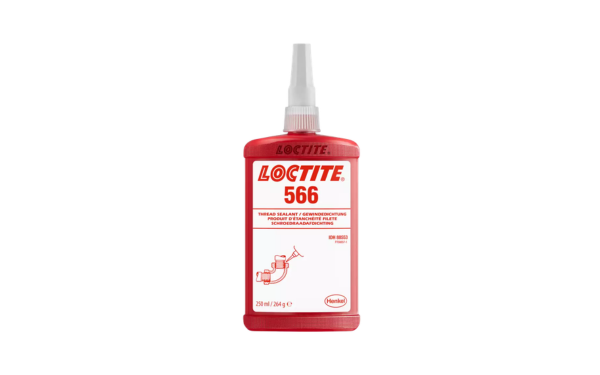
LOCTITE 566
Harmonization Code : 3506.91.90.99 | Prepared glues and other prepared adhesives, not elsewhere specified or included; products suitable for use as glues or adhesives, put up for retail sale as glues or adhesives, not exceeding a net weight of 1 kg ; Adhesives based on polymers of headings 3901 to 3913 or on rubber; Other ; Other
Main features
- Low-Strength Thread Sealing
- Vibration-Resistant Thread Sealing
- One-Component Sealing System
Product Description
LOCTITE® 566™ is a one-component, low-strength anaerobic thread sealant designed for locking and sealing close-fitting metal pipes and fittings. The brown dimethacrylate ester liquid cures when confined between mating metal surfaces in the absence of air, helping prevent loosening and leakage caused by shock and vibration. It is formulated to seal against water, oil, and most common organic materials while supporting later disassembly with standard hand tools.
Key features
- Low-strength thread sealing: Seals metal pipes and fittings while supporting service disassembly.
- Vibration-resistant locking: Helps prevent loosening and leakage caused by shock and vibration.
- One-component anaerobic cure: Requires no mixing and cures when confined between close-fitting metal surfaces.
TDS, SDS & Technical Documents
Technical Specifications
General Properties
Physical Properties
Thermal Properties
Additional Information
As-supplied / before-processing properties
Typical properties of the uncured material; values are reference data rather than guaranteed product specifications.
| Property | Value | Unit | Method / condition |
|---|---|---|---|
| Technology | Acrylic | — | Uncured material |
| Chemical type | Dimethacrylate ester | — | Uncured material |
| Appearance | Brown liquid | — | Uncured material |
| Components | One component | — | No mixing required |
| Strength classification | Low | — | Thread-sealing application |
| Specific gravity | 1.05 | — | At 25°C |
| Viscosity | 800–1,600 | mPa·s | Brookfield LVF, 25°C; spindle 2, 20 rpm |
| Viscosity | 300–400 | mPa·s | Brookfield LVF, 25°C; spindle 2, 30 rpm |
| Density | 1.05 | g/cm³ | At 20°C; SDS value |
| Flash point | >100 | °C | SDS value |
After-processing / final-state properties
Typical cured-material properties depend on the stated cure schedule, substrate, bond gap, temperature, activator use, and test method.
| Property | Value | Unit | Method / condition |
|---|---|---|---|
| Coefficient of thermal expansion | 100 × 10−6 | K−1 | ISO 11359-2 |
| Thermal conductivity | 0.1 | W/(m·K) | ISO 8302 |
| Specific heat | 0.3 | kJ/(kg·K) | Typical cured-material property |
| Breakaway specific resistance | 2–5 | N·m | M10 steel nuts and bolts; cured 24 hours at 22°C |
| Prevail specific resistance | 1.6–4 | N·m | M10 steel nuts and bolts; cured 24 hours at 22°C |
| Breakaway torque | 6–12 | N·m | ISO 10964; M10 steel nuts and bolts; cured 24 hours at 22°C |
| Prevail torque | 5–11 | N·m | ISO 10964; M10 steel nuts and bolts; cured 24 hours at 22°C |
| Motor-oil resistance | 100 | % initial strength | 5W/30 motor oil at 125°C; 1,000-hour exposure |
| Water/glycol resistance | 90 | % initial strength | 50/50 water/glycol at 87°C; 1,000-hour exposure |
| Acetone resistance | 80 | % initial strength | At 22°C; 1,000-hour exposure |