DOWSIL TC-5622 THERMALLY CONDUCTIVE COMPOUND
Harmonization Code : 3506.10.00.00 | Prepared glues and other prepared adhesives, not elsewhere specified or included; products suitable for use as glues or adhesives, put up for retail sale as glues or adhesives, not exceeding a net weight of 1 kg
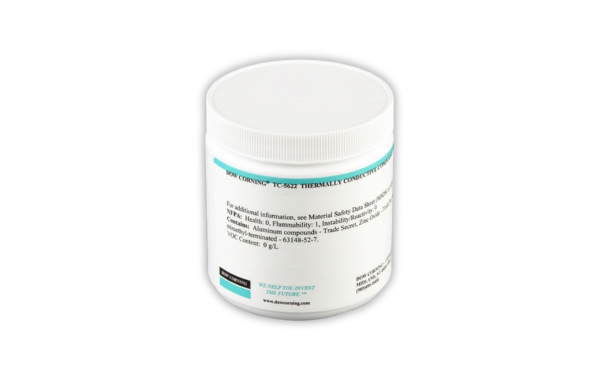
Main features
- 4.3 W/(m K) Thermal Conductivity
- 0.06 deg C cm^2/W Thermal Resistance
- Non-Curing, Solventless Compound for Dispensing or Printing
Product Description
DOWSIL™ TC-5622 Thermally Conductive Compound is a grey, flowable, non-curing silicone thermal interface compound for transferring heat from electronic devices and PCB assemblies to heat sinks or chassis surfaces. The solventless, filled polydimethylsiloxane formulation has a typical thermal conductivity of 4.3 W/m·K and can achieve a thin 0.02 mm bondline. At a reported pressure of 25 N/cm², its typical area-normalised thermal resistance is 0.06 °C·cm²/W. The material can be dispensed, stencil printed, or screen printed and remains non-curing, supporting straightforward application and rework in computer MPU, power-module, and other electronics cooling interfaces.
Key Features
- Non-curing, solventless silicone thermal compound
- Typical thermal conductivity of 4.3 W/m·K
- Typical thermal resistance of 0.06 °C·cm²/W at 25 N/cm²
- Typical 0.02 mm bondline thickness under the reported test condition
- Flowable 95,000 cP consistency for dispense, stencil-print, or screen-print application
- Grey grease-like form with low bleed and high-temperature stability positioning
- Reworkable thermal interface for modules, PCB assemblies, heat sinks, and chassis
Suitable for
- Computer MPU-to-heat-sink interfaces
- Power-module cooling interfaces
- PCB assembly-to-heat-sink or chassis interfaces
- Dispensed, stencil-printed, and screen-printed thermal interface processes
TDS, SDS & Technical Documents
Technical Specifications
Physical Properties
General Properties
Thermal Properties
Additional Information
DOWSIL™ TC-5622 Thermally Conductive Compound
A grey, flowable, non-curing silicone compound that fills microscopic surface irregularities between electronic devices or PCB assemblies and heat sinks or chassis surfaces. Its 4.3 W/m·K typical thermal conductivity, low reported thermal resistance, and ability to form a thin bondline support efficient interface heat transfer while retaining a reworkable grease-like form.

Material form and physical properties
TC-5622 is a filled polydimethylsiloxane compound supplied as a grey, grease-like, non-curing material. The values below are typical and are not sales specifications.
| Property | Typical value / characteristic | Selection relevance |
|---|---|---|
| Physical form | Grey grease-like compound | Non-curing interface material intended to remain in a grease state after installation. |
| Composition | Filled polydimethylsiloxane | Silicone matrix with heat-conductive metal-oxide fillers. |
| Viscosity | 95,000 cP (95 Pa·s) | Supports dispense, stencil-print, and screen-print process evaluation. |
| Specific gravity | 2.5 typical | Useful for estimating applied mass from material volume. |
| SDS relative density | 2.55 typical | The SDS reports a closely aligned relative density; treat this as a context-dependent source difference rather than a specification conflict. |
Apply a controlled, thin thermal interface
Apply TC-5622 by dispensing, stencil printing, or screen printing to create a continuous interface between the heat source and heat sink or chassis. Assemble the mating surfaces with controlled pressure and material quantity so the compound fills surface irregularities without an unnecessarily thick layer. Because the material does not cure, installed retention depends on the mechanical assembly and interface design.
- Clean and prepare the mating surfaces using an assembly-specific procedure.
- Control the printed or dispensed quantity to target the required bondline and coverage.
- Avoid routine solvent exposure; only minimal or intermittent solvent exposure is described as generally resistant.
- Validate squeeze-out, migration, bleed, pump-out, rework, and thermal performance in the intended assembly.
.png)
Dispense
Apply metered dots, beads, or patterns where automated placement and part-specific coverage are required.
Stencil print
Use a controlled stencil to deposit repeatable shapes and material volume across multiple interface locations.
Screen print
Suitable for patterned application where the equipment, mesh, print settings, and transfer efficiency are validated for the material.
Storage and handling
Store TC-5622 in its original, properly labelled packaging with the cover tightly attached to limit contamination. Follow any special storage instructions and the expiry date shown on the product label. Before handling, review the current regional safety documentation and container label. Use adequate ventilation and suitable workplace controls based on the applicable risk assessment.
Bulk conductivity and pressure-dependent interface data
Thermal conductivity describes the bulk compound, while the reported thermal resistance is tied to the stated pressure and bondline. Installed performance also depends on surface finish, interface area, assembly pressure, material coverage, orientation, and operating conditions.
| Property | Typical value | Required context |
|---|---|---|
| Thermal conductivity | 4.3 W/m·K | Bulk-material property; it does not independently establish total interface or system resistance. |
| Area-normalised thermal resistance | 0.06 °C·cm²/W | Reported at 25 N/cm²; preserve pressure and bondline when comparing materials. |
| Bondline thickness | 0.0008 in (0.02 mm) | Reported with the associated thermal-resistance condition; not a universal installed thickness. |
Do not compare the 4.3 W/m·K conductivity or 0.06 °C·cm²/W resistance directly with another TIM unless the test method, bondline, pressure, temperature, and interface configuration are sufficiently aligned.
Thin, reworkable thermal interfaces for electronics cooling
TC-5622 is designed for cooling modules, including computer MPUs and power modules. Application suitability depends on interface pressure, gap, surface condition, mechanical retention, orientation, electrical requirements, and the operating environment.
.png)
.png)
.png)
Evaluate TC-5622 for your thin thermal interface
Krayden can help review interface pressure, target bondline, surface condition, dispensing or printing method, material coverage, mechanical retention, rework requirements, and assembly-level thermal validation for DOWSIL™ TC-5622.