DOWSIL TC-4535
Harmonization Code : 3824.99.92.97 | Prepared binders for foundry molds or cores; chemical products and preparations of the chemical or allied industries (including those consisting of mixtures of natural products), not elsewhere specified or included: other : other : other
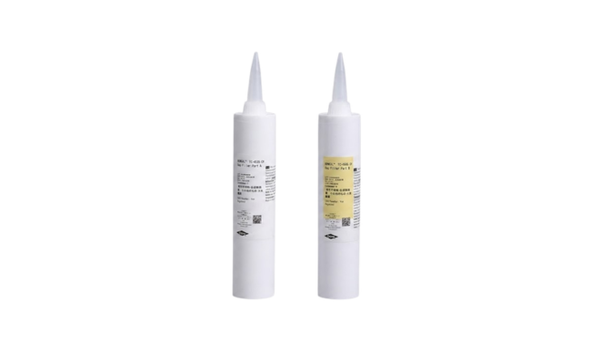
Main features
- 3.4 W/(m K) Thermal Interface
- 60-Minute Working Window
- 52 Shore 00 Hardness with Vertical-Hold Rheology
Product Description
DOWSIL™ TC-4535 CV Thermally Conductive Gap Filler is a two-part, blue, addition-cure silicone thermal interface material designed to dissipate heat from PCB-mounted electronics to heat sinks or aluminium housings. Parts A and B mix at a simple 1:1 ratio by weight or volume. The mixed material has a typical 205 Pa·s viscosity at 10 s-1, thixotropic index of 3.6, and 60-minute working time at 25°C. Supported cure schedules are 120 minutes at 25°C or 10 minutes at 80°C. Typical cured properties include 3.4 W/m·K thermal conductivity, 52 Shore 00 hardness, 22 kV/mm dielectric strength, and 8 ppm volatile siloxane content from D4 through D10.
Key features
- Two-part, 1:1 thermally conductive silicone gap filler
- Typical 3.4 W/m·K thermal conductivity
- Room-temperature or 80°C heat-accelerated cure
- Soft 52 Shore 00 cured interface for gap conformity
- Thixotropic rheology that supports processability and vertical hold
- Controlled volatile siloxane content of 8 ppm for D4–D10
- UL 94 V-0 recognition, subject to the current listed formulation and test construction
Applications
- Engine-control modules
- Transmission-control units
- Power-electronics assemblies
- PCB-to-heat-sink or PCB-to-aluminium-housing thermal interfaces
TDS, SDS & Technical Documents
Technical Specifications
General Properties
Thermal Properties
Physical Properties
Electrical Properties
Additional Information
DOWSIL™ TC-4535 CV Thermally Conductive Gap Filler
A blue, two-part silicone thermal interface material designed to transfer heat from PCB-mounted electronics into heat sinks or aluminium housings. The 1:1 system combines soft cured properties, thixotropic vertical hold, controlled volatile siloxane content, and room-temperature or accelerated cure for engine modules, transmission-control units, power electronics, and related assemblies.
.png)
White Part A, blue Part B, and blue mixed material
Confirm that each component is homogeneous before use. Mix at 1:1 by weight or volume; light-coloured streaks or marbling indicate inadequate mixing.
| Property | Part A | Part B | Mixed material |
|---|---|---|---|
| Colour | White | Blue | Blue |
| Viscosity at 10 s-1 | 200 Pa·s | 230 Pa·s | 205 Pa·s |
| Mix ratio | 1:1 by weight or volume | ||
| Mixed thixotropic index | 3.6, measured as 1 s-1/10 s-1 | ||
| Working time at 25°C | 60 minutes, defined by the TDS as the time for viscosity to double | ||
Re-homogenise, meter 1:1, mix uniformly, dispense and cure
- Check both components for minor separation after transportation and re-homogenise where required.
- Use a static mixer for manual or automated dispensing.
- Reject or continue mixing if light streaks or marbling remain.
- Automated airless dispensing can reduce or avoid de-airing.
- Use only an approved vacuum schedule if void reduction is necessary; the legacy TDS residual-pressure wording is ambiguous.
- Cure for 120 minutes at 25°C or 10 minutes at 80°C.
- Allow for component and housing warm-up before starting the heat-cure dwell.
- Addition cure progresses through deep or confined sections without cure by-products or cure exotherm.
.png)
Storage and industrial handling
The product-specific TDS reports a 360-day shelf life at 25°C. Store in the original packaging with covers tightly attached, follow special instructions on the label, and use the material by the labelled expiry date. Read the current regional SDS documents and container labels before handling. The product is neither tested nor represented as suitable for medical or pharmaceutical uses.
Soft gap conformity with thickness-dependent thermal resistance
Thermal conductivity is a bulk property. The published thermal resistance rises with test thickness, so installed performance must be evaluated using the actual gap, pressure, interfaces, contact area, void level, surface condition, and cure.
| Property | Typical value | Test context |
|---|---|---|
| Thermal conductivity | 3.4 W/m·K | Hot Disk, ISO 22007-2. |
| Thermal resistance at 120 µm | 0.45 °C·cm²/W | ASTM D5470. |
| Thermal resistance at 501 µm | 1.52 °C·cm²/W | ASTM D5470. |
| Thermal resistance at 1500 µm | 4.47 °C·cm²/W | ASTM D5470. |
| Minimum bondline at 0.14 MPa | 95 µm | CTM 1470 controlled test. |
| Minimum bondline at 0.42 MPa | 61 µm | CTM 1470 controlled test. |
| Hardness | 52 Shore 00 | ASTM D2240. |
| Specific gravity, cured | 3.1 | ASTM D792. |
| Heat capacity | 0.823 J/g·°C at 20°C; 0.962 at 80°C; 1.071 at 150°C | ASTM E1269. |
| Volatile siloxanes D4–D10 | 8 ppm | ASTM F2466 / CTM 0839. |
| Dielectric strength | 22 kV/mm | ASTM D149; breakdown property, not working voltage. |
| Volume resistivity | 3 × 10¹³ ohm-cm | ASTM D257. |
| Dielectric constant / dissipation factor | 6.5 / 0.005 at 1 MHz | ASTM D150. |
Bridge PCB assemblies to heat sinks or aluminium housings
TC-4535 CV is directly positioned for engine modules, transmission-control units and power electronics where a soft cured interface must fill irregular gaps and maintain vertical placement. Final qualification should establish the supported gap range, dispensed volume, compression pressure, bondline thickness, housing flatness, void level, wet-out, cure, thermal resistance, vibration, temperature cycling and electrical spacing.

.png)
.png)
Validate DOWSIL™ TC-4535 CV for your thermal gap and assembly
Krayden can help review gap range, dispense volume, 1:1 metering, static mixer selection, de-airing, vertical hold, pressure, bondline thickness, cure profile, installed thermal resistance, controlled-volatility requirements, temperature cycling and assembly qualification.