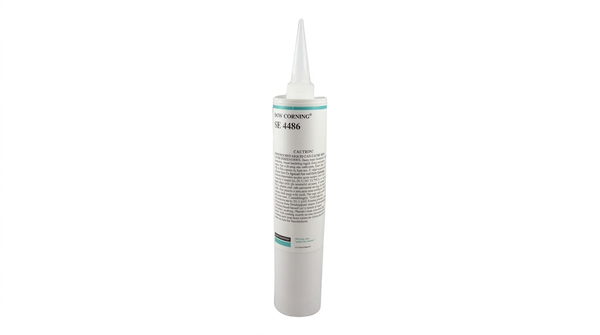
DOWSIL SE 4486
Harmonization Code : 3506.10.00.00 | Prepared glues and other prepared adhesives, not elsewhere specified or included; products suitable for use as glues or adhesives, put up for retail sale as glues or adhesives, not exceeding a net weight of 1 kg
Main features
- 1.6 W/(m K) Thermal Conductivity
- Four-Minute Tack-Free Time
- 1.65 MPa Lap Shear
Product Description
DOWSIL™ SE 4486 Thermally Conductive Adhesive is a one-part, white, semi-flowable silicone adhesive designed to provide efficient thermal transfer for cooling modules, including home-appliance devices. The material cures at room temperature through exposure to atmospheric moisture and has a typical 19,600 cP viscosity, 60 mm fluidity, and four-minute tack-free time at 25°C. Typical cured properties include 1.6 W/m·K thermal conductivity, 81 Shore A hardness, 3.9 MPa tensile strength, 43% elongation, and 1.65 MPa unprimed glass-to-glass lap-shear adhesion.
Key features
- One-part, ready-to-use moisture-cure silicone adhesive
- White, semi-flowable material with 19,600 cP viscosity
- Fast four-minute tack-free time at 25°C
- Typical 1.6 W/m·K thermal conductivity
- Noncorrosive moisture-cure by-product positioning
- Unprimed adhesion positioning on selected reactive substrates
- Long-term silicone-use range generally stated as -45°C to 200°C, subject to assembly validation
Applications
- Cooling modules in home-appliance devices
- Thermal bridging between heat-generating devices and heat-transfer media
- Electronic assemblies requiring a semi-flowable moisture-cure adhesive
- Moisture-accessible joints using validated metals, ceramics, glass, laminates, resins, or plastics
TDS, SDS & Technical Documents
Technical Specifications
General Properties
Thermal Properties
Additional Information
DOWSIL™ SE 4486 Thermally Conductive Adhesive
A white, one-part silicone adhesive developed to provide efficient thermal transfer for cooling modules, including home-appliance devices. The semi-flowable material cures through atmospheric moisture to form a durable, relatively low-stress elastomer with a noncorrosive cure by-product.

Ready-to-use white semi-flowable adhesive
No resin-to-hardener mixing is required. The published values are typical results rather than product specifications, and dispensing performance must be validated with the selected package, nozzle, pressure, temperature, and equipment.
| Property | Typical value | Context |
|---|---|---|
| Number of parts | One | Ready to use; no mix ratio. |
| Colour | White | Semi-flowable moisture-cure adhesive. |
| Viscosity | 19,600 cP | Equivalent to 19.6 Pa·s. |
| Fluidity | 60 mm | Published TDS result. |
| Tack-free time at 25°C | 4 minutes | Surface-cure result, not complete depth cure. |
Prepare compatible surfaces, dispense, assemble, and maintain atmospheric-moisture access
- Remove oils, greases, release agents, oxide films, dust, and other surface contaminants.
- Validate adhesion using lap-shear or similar testing and target cohesive adhesive failure.
- Control nozzle, pressure, speed, adhesive temperature, deposit volume, and final bondline thickness.
- Cure at room temperature within the supplier's general 0–80% relative-humidity guidance.
- Do not interpret the four-minute tack-free time as full-depth cure.
- Greater than 90% of full physical properties may be reached within approximately 4–7 hours, depending on actual product and cure conditions.
- Avoid highly confined or deep-section designs unless cure feasibility is demonstrated.
- General moisture-cure depth guidance is approximately 6.35 mm per seven days.
.png)
Storage and industrial handling
Store the product in its original packaging with the cover tightly attached, follow any special instructions on the label, and use it by the labelled expiry date. Keep the package protected from moisture and contamination. The TDS does not include complete safety information; read the current regional SDS and container label before handling. The product is not tested or represented as suitable for medical or pharmaceutical uses.
Thermal, mechanical, and adhesion properties
The following values are typical material or glass-joint results, not specifications. Installed thermal resistance and bond durability depend on bondline thickness, surface preparation, cure depth, geometry, mechanical stress, and environmental exposure.
| Property | Typical value | Context |
|---|---|---|
| Specific gravity | 2.6 | Cured material. |
| Thermal conductivity | 1.6 W/m·K | Bulk cured-material property. |
| Hardness | 81 Shore A | JIS method. |
| Tensile strength | 3.9 MPa (570 psi) | Bulk-material result. |
| Elongation at break | 43% | Typical cured-material value. |
| Unprimed glass-to-glass lap shear | 1.65 MPa (240 psi) | Substrate-specific joint result, not universal adhesion. |
Use the adhesive as a thermal bridge only after validating cure and adhesion
The product is designed for efficient thermal transfer in cooling modules, including home-appliance devices. Dow also describes general unprimed-adhesion potential on many reactive metals, ceramics, glass, selected laminates, resins, and plastics. Non-reactive metals and low-surface-energy plastics such as PTFE, polyethylene, and polypropylene should not be assumed compatible. Surface treatment or primer may be required, and highly plasticised substrates can inhibit adhesion.
.png)
.png)
.png)
Validate DOWSIL™ SE 4486 for your moisture-cure thermal bond
Krayden can help review dispensing, bondline geometry, atmospheric-moisture access, cure depth, surface preparation, substrate testing, primers, installed thermal resistance, service-temperature exposure, and assembly qualification.