DOWSIL SE 1700
Harmonization Code : 3506.91.90.99 | Prepared glues and other prepared adhesives, not elsewhere specified or included; products suitable for use as glues or adhesives, put up for retail sale as glues or adhesives, not exceeding a net weight of 1 kg ; Adhesives based on polymers of headings 3901 to 3913 or on rubber; Other ; Other
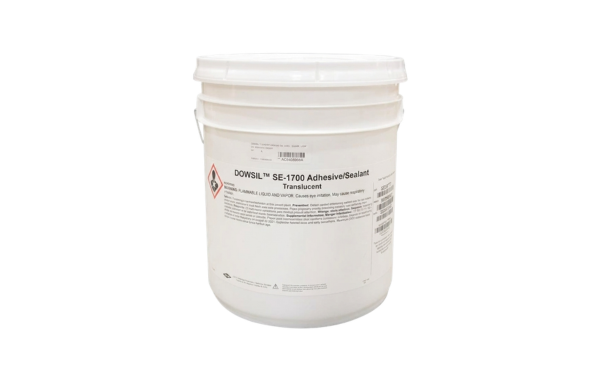
Main features
- Two-Part Bonding System
- Extended Working Time
- Heat-Accelerated Bonding Cure
Product Description
DOWSIL™ SE 1700 Adhesive is a two-part, translucent or white, non-flowing polydimethylsiloxane adhesive. It is designed with a 10:1 mix ratio and utilizes a heat cure system that allows for rapid, versatile processing controlled by temperature. Featuring a long working time after mixing, it significantly reduces the need for equipment purging and clean-up while delivering high tensile strength.
Product Key Features
- Two-Part System - supplied in two parts that use a simple 10:1 mix ratio by weight, which simplifies the proportioning process.
- Extended Working Time - offers a long working time (pot life) of 8 hours at 25°C, giving users greater manufacturing flexibility and reducing material waste.
- Heat-Accelerated Cure - the cure rate is rapidly accelerated with heat, achieving full cure in 30 minutes at 150°C.
- Robust Mechanical Profile - cures to deliver a high tensile strength of 6.8 MPa (985 psi), a Shore A hardness of 48, and 355% elongation.
- Excellent Electrical Properties - provides reliable insulation with a dielectric strength of 22 kV/mm and a volume resistivity of 5.0E+14 ohm·cm.
Applications
This adhesive is formulated to enhance the reliability and service life of PCB assemblies, offering unprimed adhesion to reactive metals, ceramics, glass, and selected plastics].
- Component Sealing: Ideal for sealing ceramic condensers and various PCB components.
- Device Assembly: Functions effectively as a bonding agent for PC keypads.
TDS, SDS & Technical Documents
Technical Specifications
General Properties
Physical Properties
Mechanical Properties
Electrical Properties
Additional Information
DOWSIL™ SE 1700 Adhesive
DOWSIL™ SE 1700 Adhesive is a premium two-part, translucent or white, non-flowing addition-cure silicone adhesive system engineered for high-performance structural sealing and electrical insulation. Formulated as a high tensile strength polydimethylsiloxane compound, it exhibits a user-friendly 10:1 mixing configuration by weight that eliminates the need for lot matching. This product cross-links smoothly under heat activation without releasing volatile cure by-products, enabling uniform depth cross-linking in fully confined boundaries. Offering a long working time post-mixing, it drastically limits manufacturing waste and helps lower total operations overhead across critical PCB electronics assemblies.
Typical engineering data parameters only. Cure schedules are rapidly accelerated by choosing elevated thermal processing profiles.

Key Features
- Two-part addition-cure structural silicone releases zero by-products, enabling deep-section and confined curing.
- Thixotropic non-flowing paste rheology provides excellent bead control on perpendicular or overhead paths.
- Delivers high continuous tensile strength (985 psi) combined with moderate elastomeric flexibility (355% elongation).
- Long working pot life (8 hours at 25°C) reduces material scrap and limits manufacturing equipment purging steps.
- Excellent dielectric properties with a volume resistivity of 5.0E+14 ohm-cm to enhance electronics reliability.
- Establishes reliable unprimed primerless adhesion over many reactive metals, ceramics, and structural glass.
Processing Summary
Process Notes
- Delivers a stable 18-month usable shelf life from production date when stored unopened at 25°C (77°F).
- Store components strictly inside original protective packaging elements to prevent contamination.
- Track plant inventories carefully against the official "Use Before" date fields marked on the labels.
- Thoroughly clean and degrease all target mating faces using Dow OS fluids, naphtha, mineral spirits, or MEK.
- Do not employ acetone or isopropyl alcohol (IPA) alone, as they exhibit poor performance removing heavy oils.
- Introduce fine localized mechanical surface abrasion to expand active clean contact bonding surface area.
- A final surface wipe with acetone or IPA following mechanical texturing can prove highly useful.
- Addition-cure platinum catalysts are susceptible to chemical inhibition when in contact with active substances.
- Prevent line contact with organotin/organometallic compounds, tin-catalyzed silicone rubbers, and sulfur.
- Isolate module joints from polysulfides, polysulfones, unsaturated hydrocarbon plasticizers, and solder flux residues.
- The presence of liquid or uncured material at the contact boundary interface signifies active cure inhibition.
- Unprimed adhesion is excellent on reactive boundaries, but non-reactive links like Teflon, PE, or PP require aid.
- Incorporate chemical etching or plasma treatments to establish a reactive bonding face on difficult materials.
- Apply specialized Dow chemical primers to increase the chemical bond activity across challenging matrices.
- In applications sensitive to air entrapment, incorporate a vacuum de-air schedule of 28 to 30 inches Hg.
Engineering Data for DOWSIL™ SE 1700
Physical & Cured Mechanical Performance Properties
| Physical Property Parameter | Typical Engineering Value | Test Condition / Standard Basis |
|---|---|---|
| Appearance | Translucent or white non-flowing paste | - |
| Mixed Viscosity | 542,000 cP | - |
| Working Time (Pot Life) | 8 hours | Measured at 25°C |
| Specific Gravity (Cured) | 1.13 | - |
| Durometer Hardness | 48 Shore A | - |
| Tensile Strength | 985 psi (6.8 MPa / 69 kg/cm²) | - |
| Elongation at Break | 355 % | - |
| Unprimed Adhesion (Lap Shear) | 390 psi (2.7 MPa / 268 N/cm²) | - |
Electrical Insulation Performance (JIS K 6249)
| Electrical Parameter | Typical Engineering Value | Test Condition / Specification Notes |
|---|---|---|
| Dielectric Strength | 550 Volts/mil (22 kV/mm) | - |
| Volume Resistivity | 5.0E+14 ohm cm | - |
| Dielectric Constant (Permittivity) | 3.0 | Measured at 1 MHz |
| Dissipation Factor | 0.001 | Measured at 1 MHz |
Where DOWSIL™ SE 1700 Fits
.png)
- Maintains insulation properties under broad conditions.
- Bonds components firmly to limit vibrational structural stress.
- Protects assemblies to extend overall module service life.

- Addition cure progresses without structural shrinkage.
- Unprimed dính bám locks cleanly to ceramic surfaces.
- High dielectric constants maintain stable operating envelopes.

- Non-flowing thixotropic paste resists running during cure.
- Withstands severe mechanical cycling via high tensile thresholds.
- Favorable processing timelines provide extensive plant assembly flexibility.
Standard Packaging & Technical Help
- Supplied in nominal 0.45 kg, 3.6 kg, 18 kg, and 200 kg (1, 8, 40, and 440 lb) net weight packages.
- Configured as component pairs that do not require explicit plant lot matching.
- Specialized bladder packs or alternative tube lines may be available for select volumes.
- Calibrating automated fluid equipment to maintain continuous 10:1 proportioning accuracy.
- Screening composite multi-material sub-assemblies to eliminate platinum catalyst cure inhibition.
- Advising on vacuum degassing parameters (28 to 30 inches Hg) to negate air entrapment.
- Coordinating small-scale laboratory substrate evaluations to confirm 100% cohesive failure targets.
Tips and Troubleshooting
| Issue | Recommended Action |
|---|---|
| Light-colored streaks, marbling trends, or spotty incomplete curing visible across the bead |
|
| Adhesive material remains liquid or tacky at the interface boundary following thermal bake |
|
| Adhesion tracking breakdown or low lap shear force values over specified assembly parts |
|