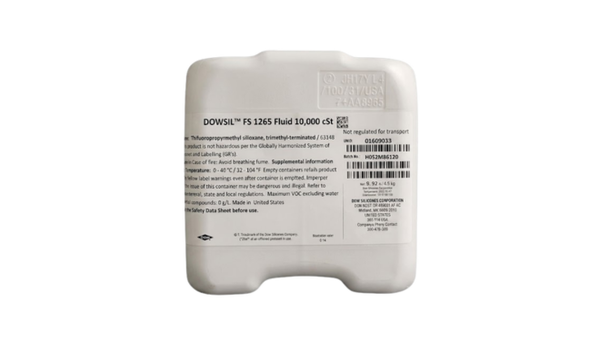
DOWSIL FS1265
Harmonization Code : 3909.20.00.90 | Amino-resins, phenolic resins and polyurethanes, in primary forms : Melamine resins : Other
Main features
- 100% Active Fluorosilicone Foam Control
- Chlorinated-Solvent-Insoluble Foam-Control Formulation
- 300/1,000/10,000 mm^2/s Viscosity Grades
Product Description
DOWSIL™ FS 1265 Fluid is a clear, colorless, 100% active fluorosilicone polymer used for persistent foam control in non-aqueous solvent systems. Its low surface tension, resistance to chemicals and oxidation, and insolubility in chlorinated solvents make it relevant where conventional polydimethylsiloxane fluids dissolve in the process liquid and can promote foam. The fluid can be added directly, prediluted in an acceptable process-compatible solvent, or applied to equipment surfaces that contact rising foam. Three kinematic viscosity grades, 300, 1,000 and 10,000 mm²/s, support different dispersion and solubility requirements; the 1,000 mm²/s grade is recommended for initial testing at a suggested starting concentration of 1–5 ppm.
Key features
- 100% active fluorosilicone fluid: Provides a concentrated product form for direct addition or controlled predilution.
- Persistent solvent foam control: Supports antifoaming in chemical and petroleum processes and other non-aqueous systems.
- Insoluble in chlorinated solvents: Suitable for evaluation where conventional polydimethylsiloxane fluids are soluble and may promote foam.
- Three viscosity grades: Available at 300, 1,000 and 10,000 mm²/s for balancing dispersion with antifoam efficiency.
- Low suggested starting level: Begin screening at 1–5 ppm and optimize for the specific foaming system.
Applications / Suitable for
- Solvent antifoaming in chemical and petroleum processing
- Reclaiming used chlorinated solvents after dry cleaning, solvent degreasing or solvent extraction
- Oil and gas separation
TDS, SDS & Technical Documents
Technical Specifications
General Properties
Additional Information
DOWSIL™ FS 1265 Fluid
A clear, colorless, 100% active fluorosilicone polymer for persistent foam control in non-aqueous solvent systems. It is insoluble in chlorinated solvents, may be used directly or after predilution, and is available in three viscosity grades. The fluid is also identified by Dow as an ingredient for lubricant formulations.

Concentrated fluorosilicone fluid
Viscosity grade selection
Increasing viscosity lowers solubility in the foaming solvent and can increase antifoaming efficiency, but it also makes thorough dispersion more difficult. Select the lowest viscosity grade that provides acceptable foam control; use the 1,000 mm²/s grade for initial testing.
| Viscosity grade | Specific gravity at 25°C | Refractive index at 25°C | Selection context |
|---|---|---|---|
| 300 mm²/s | 1.25 | 1.3797 | Lower-viscosity option for easier dispersion; confirm that foam control is sufficient in the target system. |
| 1,000 mm²/s | 1.27 | 1.3802 | Recommended starting grade for initial foam-control testing. |
| 10,000 mm²/s | 1.30 | 1.3809 | Lower solubility can improve antifoaming efficiency, with greater effort required for complete dispersion. |
Typical values are not intended for specification writing. Specific gravity: ASTM D1298-24. Refractive index: ASTM D1218-21.
Application and dosage
Use the fluid as supplied or predilute it in a process-compatible solvent to improve distribution. Direct addition to the liquid system is the usual method. It may also be wiped onto a vat rim or onto a screen suspended above the liquid so rising foam contacts the treated surface.
Store at or below 40°C (104°F) in the original unopened container. Under these conditions, the usable life is 48 months from the date of production. Diluted solutions may lose performance after more than four weeks of storage. Review the current product safety documentation and container label before handling. Package options include 550 lb drums, 25 kg pails, 5 kg and 1 kg packs, and 250 cc samples; confirm regional availability.
Supported foam-control applications
Application fit depends on the foaming solvent, dispersion method, grade and dose. Use representative system testing to establish the operating window.


Foam-control selection guides
These supplier guides provide broader portfolio context for application screening. Product-specific properties and use guidance on this page should remain the basis for evaluating DOWSIL™ FS 1265 Fluid.
Evaluate DOWSIL™ FS 1265 Fluid for your foam-control process
Share the solvent system, foam behavior, process temperature, available dispersion equipment and target dosing range with Krayden. Our technical team can support a controlled screening plan for viscosity grade, predilution approach and starting concentration before production qualification.