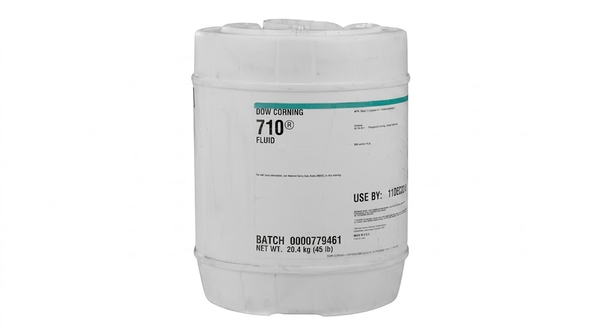
DOWSIL 710
Harmonization Code : 3403.19 | Lubricating Preparations (With 70% or More Petroleum Oils) For Automotive and Other Uses
Main features
- Up to 260 deg C Closed-System Service
- Low-Volatility Oxidation-Resistant Fluid
- High-Temperature Lubrication/Heat-Transfer Applications
Product Description
DOWSIL™ 710 Fluid is a polyphenylmethylsiloxane fluid for high-temperature lubrication and heat-transfer applications. It retains its properties during continuous use at temperatures up to 260° C in closed systems and combines low volatility with resistance to oxidation and gumming. The fluid is suitable for lubricating timing devices, instruments, and bearings operating from 0 to 260 °C. It may also be used as a base oil for high-temperature greases thickened with molybdenum disulphide and as a heat-exchange fluid in high-temperature baths and metal heat-treating baths.
Key features
- High-temperature stability: Retains its properties during continuous use at temperatures up to 260 °C in closed systems.
- Low volatility: Shows 3.0% volatility after four hours at 250 °C and has negligible vapor pressure at 25 °C.
- Oxidation and radiation resistance: Resists oxidation and gumming and remains serviceable after radiation doses of up to 200 megarads at room temperature.
Applications / Suitable for
- Timing devices, instruments, and bearings operating from 0 to 260 °C
- Base oil for high-temperature greases thickened with molybdenum disulphide
- High-temperature heat-exchange baths
- Metal heat-treating baths
TDS, SDS & Technical Documents
Technical Specifications
General Properties
Thermal Properties
Electrical Properties
Additional Information
As-supplied / before-processing properties
Typical properties of DOWSIL™ 710 Fluid. These values are not intended for use in preparing specifications.
| Property | Value | Unit | Method / condition |
|---|---|---|---|
| Color | Colorless to light straw | — | As supplied |
| Viscosity | 500 | mm²/s | At 25°C |
| Specific gravity | 1.11 | — | At 25°C/15.6°C |
| Flash point | 302 | °C | Open cup |
| Volatility | 3.0 | % | After 4 hours at 250°C |
| Vapor pressure | Negligible | kPa | At 25°C |
| Vapor pressure | 0.01 | kPa | At 149°C |
| Vapor pressure | 0.2 | kPa | At 232°C |
| Vapor pressure | 0.5 | kPa | At 260°C |
| Vapor pressure | 1.3 | kPa | At 288°C |
| Vapor pressure | 2.9 | kPa | At 316°C |
| Vapor pressure | 11.0 | kPa | At 371°C |
| Thermal decomposition point | 370 | °C | Typical value |
| Spontaneous ignition temperature | 488 | °C | Typical value |
| Freeze point | -22 | °C | Typical value |
| Coefficient of expansion | 0.00072 | 1/°C | From 0°C to 135°C |
| Sound velocity | 1370 | m/s | At 25°C |
| Compressibility | 1.70 | % | At 34.5 MPa |
| Compressibility | 3.15 | % | At 69 MPa |
| Compressibility | 5.50 | % | At 138 MPa |
| Thermal conductivity | 0.14 | W/(m·K) | At 50°C |
| Specific heat | 1.52 | kJ/(kg·K) | At 40°C |
| Specific heat | 1.64 | kJ/(kg·K) | At 100°C |
| Specific heat | 1.84 | kJ/(kg·K) | At 200°C |
| Molecular weight, average | 2600 | — | Average value |
| Refractive index | 1.533 | — | At 25°C |
| Surface tension | 28.5 | mN/m | At 25°C |
| Electric strength | 14 | kV/mm | 2.5 mm gap; rapid rise |
| Permittivity | 2.95 | — | At 25°C and 100 Hz |
| Permittivity | 2.95 | — | At 25°C and 100 kHz |
| Dissipation factor | 0.002 | — | At 25°C and 100 Hz |
| Dissipation factor | 0.0002 | — | At 25°C and 100 kHz |
| Volume resistivity | 1 × 10¹³ | ohm·cm | Typical value |