DOWSIL 3-6751
Harmonization Code : 3506.10.00.00 | Prepared glues and other prepared adhesives, not elsewhere specified or included; products suitable for use as glues or adhesives, put up for retail sale as glues or adhesives, not exceeding a net weight of 1 kg
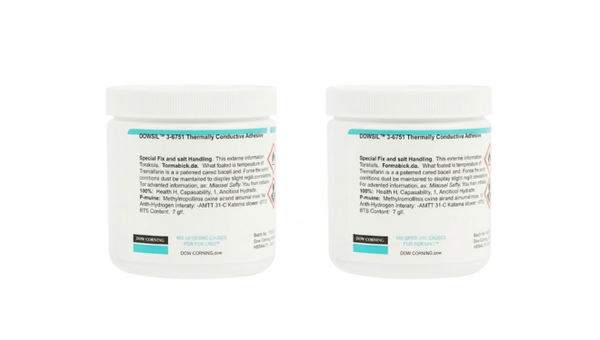
Main features
- 1.0 W/(m K) Thermal Bonding
- 9,300 cP Mixed Viscosity
- 3.5 MPa Aluminum Lap Shear
Product Description
DOWSIL™ 3-6751 Thermally Conductive Adhesive is a two-part, grey, addition-cure silicone adhesive developed for thermal transfer and structural bonding in power supplies, consumer devices, automotive electronics, and related assemblies. Parts A and B mix at a simple 1:1 ratio by weight or volume to form a highly flowable, self-levelling material with a typical 9,300 cP mixed viscosity. Supported heat-cure schedules are 50 minutes at 100°C, 40 minutes at 125°C, or 10 minutes at 150°C. Typical cured properties include 1.0 W/m·K thermal conductivity, 68 Shore A hardness, 3.5 MPa unprimed aluminium lap-shear adhesion, and 18 kV/mm dielectric strength.
Key features
- Two-part, thermally conductive, addition-cure silicone adhesive
- Simple 1:1 mix ratio by weight or volume
- Highly flowable and self-levelling with 9,300 cP typical mixed viscosity
- Multiple heat-cure options from 100°C to 150°C
- Primerless-adhesion positioning on many metals, ceramics, laminates, resins, and filled plastics
- Cures without by-products for deep-section or confined bonding
- UL 94 V-0 flammability classification, subject to the current recognised formulation and construction
Applications
- Bonding heat sinks and heat spreaders to electronic devices
- Bonding printed circuit boards and electronic substrates
- Thermal transfer in power-supply and consumer-electronics assemblies
- Automotive electronic thermal-management and bonding applications
TDS, SDS & Technical Documents
Technical Specifications
General Properties
Physical Properties
Mechanical Properties
Electrical Properties
Thermal Properties
Additional Information
DOWSIL™ 3-6751 Thermally Conductive Adhesive
A two-part, grey silicone adhesive designed to create a bonded thermal path between heat-generating components and heat-transfer structures. Its low mixed viscosity, self-levelling flow, no-by-product addition cure, and flexible cured properties support bonding in power supplies, consumer devices, automotive electronics, printed circuit assemblies, and other thermal-management designs.
.png)
Low-viscosity component and mixed properties
Thoroughly remix each component before metering because thermally conductive filler may settle during storage. Light-coloured streaks or marbling after combination indicate incomplete mixing.
| Property | Part A | Part B | Mixed material |
|---|---|---|---|
| Colour | White | Grey | Grey |
| Viscosity | 11,800 cP | 7,700 cP | 9,300 cP |
| Mix ratio | 1:1 by weight or volume | ||
| Extrusion rate | 146 g/min | ||
| Working time | Approximately 120 minutes at room temperature | ||
Redisperse filler, meter 1:1, mix uniformly, control voids, assemble, and heat cure
- Thoroughly mix Part A and Part B separately before combining them.
- Meter at 1:1 by weight or volume and mix until no light streaks or marbling remain.
- Automated airless dispensing can reduce or eliminate the need for vacuum de-airing.
- When de-airing is required, use the supplier's vacuum guidance for approximately 10 minutes or until bubbling subsides.
- For thicker or confined sections, begin process development with a 30-minute pre-cure at 70°C to reduce void risk.
- Complete cure using 50 minutes at 100°C, 40 minutes at 125°C, or 10 minutes at 150°C.
- Count cure time after the adhesive reaches the selected temperature and account for oven ramp and assembly thermal mass.
.png)
Storage and industrial handling
Store the components in their original packaging with covers tightly attached and follow the expiry date and any special storage instructions on the product labels. The supplied SDS files were not available as readable attachments in this workspace. Final publication and use require current regional SDS documents for both Part A and Part B, together with the container labels and applicable workplace ventilation, personal protection, spill, storage, and waste controls.
Thermal, mechanical, adhesion, dimensional, and electrical properties
The values below are typical material or joint-test results and are not product specifications. Installed thermal resistance and bond reliability depend on bondline thickness, contact area, surface preparation, cure, joint geometry, loading, and environmental exposure.
| Property | Typical value | Context |
|---|---|---|
| Specific gravity | 2.32 | Cured material. |
| Thermal conductivity | 1.0 W/m·K | Bulk cured-material property. |
| Hardness | 68 Shore A | Flexible cured elastomer. |
| Tensile strength | 2.8 MPa (400 psi) | Bulk-material result. |
| Elongation at break | 36% | Typical cured-material value. |
| Unprimed aluminium lap shear | 3.5 MPa (510 psi) | Aluminium joint result; not universal substrate strength. |
| Hardening transition by DSC | -48°C | Supplier-reported transition. |
| Linear coefficient of thermal expansion | 179 ppm/°C | By TMA. |
| Volume resistivity | 7.2 × 10¹³ ohm-cm | Bulk electrical property. |
| Dielectric strength | 18 kV/mm (454 V/mil) | Breakdown property, not design working voltage. |
| Dielectric constant | 4.71 at 100 Hz; 4.65 at 100 kHz | Frequency-specific values. |
| Dissipation factor | 0.0045 at 100 Hz; 0.00013 at 100 kHz | Frequency-specific values. |
Bond thermal paths only after confirming substrate compatibility and cohesive failure
The adhesive is directly positioned for thermal transfer in power-supply, consumer-device, and automotive assemblies. It can develop primerless adhesion to many metals, ceramics, glass, epoxy-laminate boards, selected resins, and filled plastics. Non-reactive metals and low-surface-energy plastics such as PTFE, polyethylene, and polypropylene may require treatment or primer and must not be assumed compatible.
.png)
.png)
.png)
Validate DOWSIL™ 3-6751 for your bonded thermal interface
Krayden can help review substrate preparation, bondline thickness, 1:1 metering, filler re-dispersion, de-airing, dispense method, thick-section pre-cure, cure profile, lap-shear validation, thermal path, service temperature, and assembly qualification.