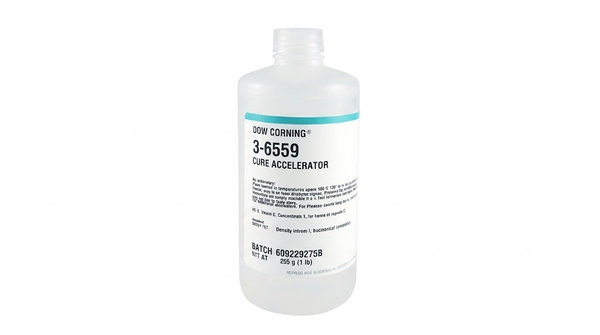
DOWSIL 3-6559
Harmonization Code : 8529.90 | Parts solely or principally used for TV, radio, and transmission
Main features
- Adjustable 1 to 5 Wt% Addition Level
- 4 to 12-Hour Cure Window
- Surface/Environment Cure-Inhibition Management
Product Description
DOWSIL™ 3-6559 Cure Accelerator is a one-part, straw-colored liquid organoplatinum additive for accelerating the cure of compatible platinum-catalyzed Silastic™ moldmaking silicones. It is mixed at 1–5% by weight into the combined silicone base and curing agent. Within the Silastic E, J, L, M, and T systems covered by the supplied technical bulletin, increasing the accelerator level progressively reduces working time and cure time. The concentrated additive may also be applied to certain inhibiting surfaces or added in small amounts to help address surface or environmental cure inhibition. Addition levels must be controlled carefully because excessive accelerator can shorten the available working time to only a few minutes.
Key features
- Concentrated organoplatinum additive: Uses the same general catalyst chemistry found in compatible platinum-catalyzed Silastic moldmaking silicone systems.
- Adjustable addition level: Recommended at 1–5% by weight of the combined base and curing-agent mixture.
- Controlled cure acceleration: Increasing the addition level reduces both working time and cure time in the identified compatible silicone grades.
- 400 cSt typical viscosity: Supplied as a pourable liquid with a typical kinematic viscosity of 400 cSt at 25°C.
- Cure-inhibition support: May be used on certain inhibiting surfaces or in small additions where environmental contaminants interfere with normal silicone cure.
Applications / Suitable for
- Accelerating the cure of compatible Silastic E, J, L, M, and T moldmaking silicones.
- Treating certain cure-inhibiting surfaces before silicone molding.
- Evaluating cure inhibition caused by contaminants in molding equipment, parts, molds, or the surrounding shop environment.
TDS, SDS & Technical Documents
Technical Specifications
No specifications available.
Additional Information
DOWSIL™ 3-6559 Cure Accelerator
DOWSIL™ 3-6559 Cure Accelerator is a concentrated, one-part organoplatinum additive used to shorten the working and cure times of compatible platinum-catalyzed Silastic moldmaking silicones. Its adjustable 1–5 wt% addition range allows the cure schedule to be selected according to the silicone grade and available processing time.

Material characteristics
| Property | Value | Unit | Method / condition |
|---|---|---|---|
| Chemical nature | Organoplatinum compound | — | Product mixture |
| Physical state | Liquid | — | As supplied |
| Color | Straw-colored | — | Typical physical data |
| Odor | Slight | — | Typical physical data |
| Kinematic viscosity | 400 | cSt | Typical at 25°C |
| Relative density | 1.00 | — | Water = 1 |
| Boiling point | >100 | °C | At 760 mmHg |
| Flash point | >101.1 | °C | Closed cup |
Physical-property values are typical and are not guaranteed specifications.
Addition level and cure-time control
Add the cure accelerator only to compatible platinum-catalyzed Silastic moldmaking silicone systems. Select the concentration according to the required working time and cure schedule, and verify the result under the actual molding conditions before production use.

Measure the accelerator by weight and distribute it thoroughly through the combined silicone base and curing-agent mixture.
Keep the material in properly labeled containers and store it in accordance with applicable local requirements. Avoid contact with strong oxidizing agents. Use adequate ventilation and follow the current safety documentation and workplace risk assessment when handling the product.
Managing cure inhibition
Evaluate cure acceleration for your silicone molding process
Krayden can help review the silicone grade, target working time, cure schedule, addition level, and potential sources of cure inhibition for your molding process. Contact us to discuss product selection, processing trials, technical information, or material availability.