COOLTHERM EP-2000
Harmonization Code : 3910.00.00.90 | Silicones in Primary Forms; Others
Main features
- 1.9 W/(m K) Thermal Encapsulation
- 1,900 cP Mixed Viscosity
- 204 deg C Glass Transition
Product Description
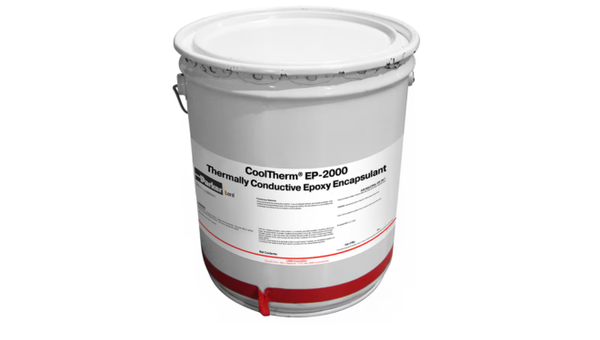
CoolTherm® EP-2000 Thermally Conductive Epoxy Encapsulant is a two-component, low-viscosity epoxy system developed for encapsulating motor stators, transformer coils, and other electrical devices with small-diameter, tightly packed windings. Its fine-particle-filled formulation combines a typical cured thermal conductivity of 1.9 W/m·K with high-temperature stability and electrical insulation. The black resin and white hardener mix at a 1:1 ratio by weight or volume to form a gray, self-leveling material suitable for manual or automated meter/mix/dispense processing.
Key features
- Thermally conductive encapsulation: Provides a typical cured thermal conductivity of 1.9 W/m·K.
- Low-viscosity, self-leveling system: The mixed material has a typical viscosity of 1,900 cP at 60 °C and a shear rate of 10/sec.
- High-temperature electrical insulation: Provides a typical glass transition temperature of 204 °C by DMA and volume resistivity of 1 × 10¹⁴ ohm-cm at 25 °C using ASTM D257.
Applications / Suitable for
- Motor stator and rotor encapsulation
- Transformer-coil encapsulation
- Electrical devices with small-diameter, tightly packed windings
TDS, SDS & Technical Documents
Technical Specifications
General Properties
Physical Properties
Thermal Properties
Electrical Properties
Additional Information
As-supplied / before-processing properties
Typical properties of the separate components and mixed encapsulant before cure. Values are not intended for specification purposes.
| Property | Value | Unit | Method / condition |
|---|---|---|---|
| Appearance | Black liquid / white liquid / gray liquid | — | Resin / hardener / mixed material |
| Mix ratio | 1:1 | By weight or volume | EP-2000 resin : EP-2000 hardener |
| Viscosity — resin | 6,080 | cP | At 60 °C; shear rate 10/sec |
| Viscosity — hardener | 1,300 | cP | At 60 °C; shear rate 10/sec |
| Viscosity — mixed | 1,900 | cP | At 60 °C; shear rate 10/sec |
| Specific gravity | 2.72 / 2.75 / 2.73 | — | Resin / hardener / mixed material at 25 °C |
| Gel time | 76 | minutes | Mixed material at 110 °C |
| Working life | >3 | hours | Mixed material at 60 °C |
After-processing / final-state properties
Typical cured properties after heating for 2 hours each at 120 °C, 150 °C, 180 °C, and 210 °C. Values are not intended for specification purposes.
| Property | Value | Unit | Method / condition |
|---|---|---|---|
| Thermal conductivity | 1.9 | W/m·K | Cured bulk material; test method not stated |
| Coefficient of linear thermal expansion | 14.9 | ppm/°C | Cured material; test method and temperature region not stated |
| Glass transition temperature | 204 | °C | DMA |
| Hardness | 95 | Shore D | ASTM D2240 |
| Young’s modulus | 17.5 | GPa | DMA |
| Volume resistivity | 1 × 10¹⁴ | ohm-cm | ASTM D257 at 25 °C |
| Dielectric strength | 18.5 (470) | kV/mm (V/mil) | ASTM D149 |