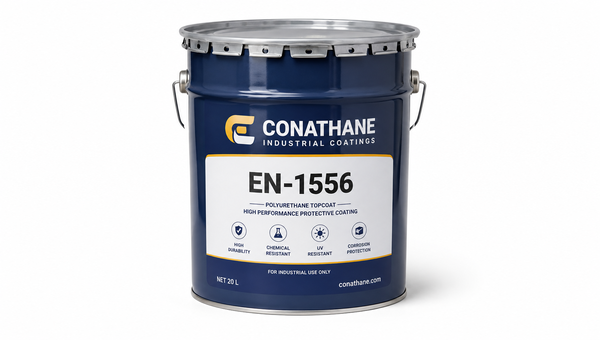
CONATHANE EN-1556
Harmonization Code : 3909.20.00.90 | Amino-resins, phenolic resins and polyurethanes, in primary forms : Melamine resins : Other
Main features
- 100% Solids Polyurethane Encapsulation System
- Meets MIL-M-24041C
- Available in Cartridge form!
Product Description
CONATHANE EN-1556 is an unfilled, two-component, 100% solids polyurethane system for potting and encapsulating electrical assemblies. Part A urethane prepolymer and Part B curative mix at 100:33 by weight or volume. The system supports room-temperature or elevated-temperature cure schedules and is used for harness breakouts, watertight connectors, electrical cables, and cable end seals. Documented applications include harness breakouts, watertight connectors, and cable end seals. Cast or inject the mixture. Meets MIL-M-24041C
Key features
- Material system: 100% solids polyurethane system.
- Mix ratio: 100:33 mix ratio by weight or volume.
- Processing window: Room-temperature or elevated-temperature cure options.
- Available in 400 ml Cartridge form from Krayden.
Applications
- Harness breakouts
- Watertight connector
- Cable end seals
- Sub Sea Connectors
Technical Specifications
General Properties
Electrical Properties
Additional Information
CONATHANE® EN-1556
Two-component polyurethane for potting, encapsulation, molding and casting
CONATHANE® EN-1556 is an unfilled, two-component, room-temperature-curing, 100% solids polyether-based polyurethane system supplied as EN-1556 Part A Urethane Prepolymer and EN-1556 Part B Curative. It is used for molding, potting and encapsulation of electrical assemblies and is also suitable for selected mechanical casting, molding and abrasion-resistant lining applications.
Performance and processing characteristics
EN-1556 combines polyurethane elastomer properties with processing options for bench casting, meter-mix dispensing and vacuum potting or casting.
Component and mixed-material properties
Part A, Part B and mixed-system values are kept separate to preserve component and process-state context.
| State | Property | Value | Unit / basis | Condition |
|---|---|---|---|---|
| Part A | Viscosity | 18,000 | cP | 25°C / 77°F |
| Part A | Specific gravity | 1.05 | Dimensionless | 25°C / 77°F |
| Part A | Appearance | Amber | Visual | As supplied |
| Part B | Viscosity | 3,000 | cP | 25°C / 77°F |
| Part B | Specific gravity | 1.03 | Dimensionless | 25°C / 77°F |
| Part B | Appearance | Amber or black | Visual | As supplied |
| Mixed system | Mix ratio | 100:33 | A:B | By weight or volume |
| Mixed system | Initial viscosity | 10,040 | cP | 25°C / 77°F |
| Mixed system | Work life to 250,000 cP | 60-70 | minutes | 2 lb batch at 25°C / 77°F |
| Mixed system | Work life to 250,000 cP | 15-20 | minutes | 2 lb batch at 60°C / 140°F |
Values are typical and are not intended for specification use.
Mix, degas, cast or inject within the documented process window
EN-1556 may be processed by hand-mix bench potting or casting, meter-mix bench potting or casting, and meter-mix vacuum potting or casting. Ordinary casting and injection-molding techniques are supported.
Room-temperature and accelerated heat-cure options
Cure times are measured after the unit reaches the specified temperature. The schedules are recommendations and should be optimized for the intended application.
| Process | Temperature | Time | Basis |
|---|---|---|---|
| Cure | 25°C / 77°F | 10-14 days | Room-temperature cure option |
| Cure | 82°C / 180°F | 16 hours | Accelerated cure option |
| Cure | 100°C / 212°F | 8-10 hours | Accelerated cure option |
| Demold | 25°C / 77°F | 24 hours | Recommended demold point |
| Demold | 80°C / 176°F | 60 minutes | Recommended demold point |
| Demold | 100°C / 212°F | 30 minutes | Recommended demold point |
Primer and mold-release guidance
Primer selection depends on the substrate. A dedicated mold release is also identified for easier removal of cast parts.
Control temperature, moisture exposure and crystallization before processing
Typical mechanical and environmental properties
These values apply to the mixed and cured EN-1556 system under the stated test methods and conditions.
| Property | Value | Unit | Method | Condition |
|---|---|---|---|---|
| Appearance | Amber or black | Visual | Visual | 25°C / 77°F |
| Specific gravity | 1.05 | Dimensionless | ASTM D792 | 25°C / 77°F |
| Shore hardness | A 80 | Shore A | ASTM D2240 | 25°C / 77°F |
| Shore hardness after heat aging | A 74 | Shore A | ASTM D2240 | After 24 h at 135°C / 275°F |
| Compression set | 35 | % | ASTM D395 Method B | Typical cured material |
| Tensile strength | 5,000 | psi | ASTM D412 | 25°C / 77°F |
| 300% modulus | 1,400 | psi | ASTM D412 | 25°C / 77°F |
| Ultimate elongation | 400 | % | ASTM D412 | 25°C / 77°F |
| Tear strength | 200 | pli | ASTM D624 | 25°C / 77°F |
| Volumetric shrinkage | 3.6 | % | MIL-M-24041C | Typical cured material |
| Moisture absorption | 2.1 | % | MIL-M-24041C | 24 h at 93°C / 200°F |
| Fungus resistance | Non-nutrient | Result | MIL-E-5272C | Tested cured system |
| Low-temperature flexibility | No blistering, cracking or loss of adhesion | Result | MIL-M-24041C | -54°C / -65°F cycles |
| Tensile-strength degradation after water immersion | 28.6 | % loss | Tensile evaluation | After 2 weeks immersion in water at 70°C / 158°F |
Typical values are not intended for specification use. Test method, conditioning and product state should be preserved when comparing performance.
Typical cured electrical performance
Electrical values apply to the cured EN-1556 system under the stated frequency, temperature, specimen and exposure conditions.
| Property | Value | Unit | Method | Condition |
|---|---|---|---|---|
| Dielectric strength | 350 | V/mil | ASTM D149 | 1/8 in. specimen at 25°C / 77°F |
| Dielectric constant | 6.1 | Dimensionless | ASTM D150 | 1 kHz at 25°C / 77°F |
| Dielectric constant | 5.1 | Dimensionless | ASTM D150 | 1 MHz at 25°C / 77°F |
| Dissipation factor | 0.03 | Dimensionless | ASTM D150 | 1 kHz at 25°C / 77°F |
| Dissipation factor | 0.06 | Dimensionless | ASTM D150 | 1 MHz at 25°C / 77°F |
| Volume resistivity | 2.4 × 10¹² | ohm-cm | ASTM D257 | 25°C / 77°F |
| Volume resistivity | 9.6 × 10¹⁰ | ohm-cm | ASTM D257 | 121°C / 250°F |
| Surface resistivity | 5.2 × 10¹³ | ohms/sq. | ASTM D257 | 25°C / 77°F |
| Surface resistivity | 3.5 × 10¹⁰ | ohms/sq. | ASTM D257 | 121°C / 250°F |
| Insulation resistance | 900,000 | megohms | MIL-M-24041C | 25°C / 77°F |
| Insulation resistance | 4,200 | megohms | MIL-M-24041C | 121°C / 250°F |
| Insulation resistance | 35,000 | megohms | MIL-M-24041C | After 10 days at 95% RH |
| Arc resistance | >120 | seconds | MIL-M-24041C | 25°C / 77°F |
| High-potential resistance | No breakdown | Result | MIL-M-24041C | 2,000 V RMS at 60 Hz |
| Flame resistance | No ignition | Result | MIL-M-24041C | 55 A DC |
Typical electrical values are not intended for specification use and should be evaluated under the stated test conditions.
Supported electrical and mechanical application areas
EN-1556 is primarily used as a molding, encapsulating and potting compound for electrical assemblies, with additional mechanical casting and abrasion-resistant lining applications.
Discuss CONATHANE® EN-1556 with Krayden
Review EN-1556 for your potting, encapsulation, molding or casting process with Krayden. Share your assembly geometry, substrate materials, dispensing method, processing temperature, cure requirements and target final-state properties to support a technically appropriate material evaluation.