Araldite® CY 8763 Resin / Aradur® HY 8763 Hardener
Harmonization Code : 3506.91.90.99 | Prepared glues and other prepared adhesives, not elsewhere specified or included; products suitable for use as glues or adhesives, put up for retail sale as glues or adhesives, not exceeding a net weight of 1 kg ; Adhesives based on polymers of headings 3901 to 3913 or on rubber; Other ; Other
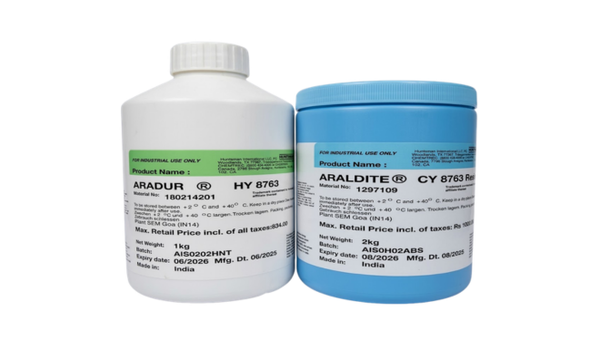
Main features
- Epoxy System for Battery Encapsulation
- 2:1 Controlled Mixing
- 700 V/mil Dielectric Strength
Product Description
ARALDITE CY 8763 resin and ARADUR HY 8763 hardener form a two-component epoxy system for sealed lead-acid storage batteries. The system is used for potting, sealing, and encapsulation where sulfuric-acid resistance is required. It mixes at 2:1 by volume; at 25 deg C, the initial mixed viscosity is approximately 3,500 cP and the typical 300 g pot life is about 20 minutes. Documented applications include lead-acid battery terminal potting, battery sealing, and battery encapsulation.
Key features
- Application fit: Two-component epoxy system designed for sealed lead-acid battery potting, sealing, and encapsulation.
- Mix ratio: 2:1 by-volume mix ratio with approximately 3,500 cP initial mixed viscosity at 25 deg C.
- Final properties:: Typical cured Shore D 80-90 hardness with 700 V/mil dielectric strength under the stated IEC test condition.
Applications
- Lead-acid battery terminal potting
- Battery sealing
- Battery encapsulation
Technical Specifications
General Properties
Thermal Properties
Electrical Properties
Additional Information
Potting, Encapsulation & Battery Materials
Acid-resistant epoxy system for sealed lead-acid battery encapsulation
ARALDITE CY 8763 resin and ARADUR HY 8763 hardener form a two-component epoxy system designed for sealed lead-acid storage batteries. The system is documented for potting, sealing, and encapsulation where sulfuric-acid resistance is required. At 25 deg C, the initial mixed viscosity is approximately 3,500 cP and the typical 300 g pot life is about 20 minutes.
As supplied
Component properties
Resin and hardener properties are shown separately before mixing.
| Property | ARALDITE CY 8763 resin | ARADUR HY 8763 hardener | Method |
|---|---|---|---|
| Appearance | Red liquid | Amber liquid | Visual |
| Density | 1.13-1.17 g/cm3 | 1.03-1.07 g/cm3 | ASTM D-792 |
| Viscosity at 25 deg C | 2,000-5,000 cP | 2,000-5,000 cP | ASTM D-2393 |
| Mix ratio by weight | 100 | 46 | System ratio |
| Mix ratio by volume | 100 | 50 | System ratio |
Processing
Mix thoroughly, degas when needed, and fill from the lowest point
Manual mixing or meter-mix dispensing can be used. For potting and encapsulation, the handling sequence is designed to limit entrapped air while allowing the material to flow around subcomponents.
- Combine resin and hardener at 100:46 by weight or 100:50 by volume.
- Mix thoroughly and scrape the sides and walls of the container. A minimum of 1 minute is suggested; 3-5 minutes is identified as optimal.
- For potting or encapsulation, vacuum degas before dispensing when air-bubble reduction is required.
- Pour or dispense at the lowest point and keep a thin, continuous stream rather than moving the stream back and forth.
- Typical processing data: initial mixed viscosity ~3,500 cP at 25 deg C, pot life ~20 minutes for 300 g at 25 deg C, gel time 8-16 minutes at 60 deg C, and recommended cure time 60 minutes at 60 deg C.
Storage and handling
Dry, sealed storage for both components
Store ARALDITE CY 8763 resin and ARADUR HY 8763 hardener in their original sealed containers in a dry place at 2-40 deg C (36-104 F).
Under these conditions, shelf life is 12 months from date of manufacture. Protect the products from direct sunlight.
Technical guidance
Control air introduction during battery potting
The documented handling sequence focuses on minimizing bubbles during encapsulation.
Degas before potting
Vacuum degas the mixed material before potting when air-bubble reduction is required.
Dispense from the lowest point
Introduce the material at the lowest point and allow it to flow around and through subcomponents.
Use a thin continuous stream
Keep the stream thin and continuous to help break bubbles and avoid introducing additional air.
Cured system
Typical cured properties
These values apply to the complete CY 8763 / HY 8763 system after cure.
| Property | Typical value | Method / condition |
|---|---|---|
| Glass transition temperature | 60-80 deg C | DSC |
| Lap shear strength at break | >1,200 psi | ASTM D-1002 |
| Peak exotherm temperature | 176 deg C | DSC |
| Average weight gain in sulfuric acid | 1.02 wt.% | 24 h at 60 deg C |
| Hardness | Shore D 80-90 | ASTM D-2240 |
| Thermal conductivity | 0.263 W/m-K | ASTM E-1225 |
| Dielectric strength | 700 V/mil | IEC 60243-1; 1/8 in plaque, 23 deg C, 50 Hz |
Unless otherwise stated, these are typical values and not a product specification.
Applications
Supported applications
Use the documented application scope below as the starting point for product evaluation.
Lead-acid battery terminal potting
Potting around terminals in sealed lead-acid storage batteries where sulfuric-acid resistance is required.
Battery sealing
Sealing functions in sealed lead-acid battery assemblies using the documented CY 8763 / HY 8763 system.
Battery encapsulation
Encapsulation of battery components where the specified epoxy system and thermoplastic housing compatibility are suitable.
Technical support for ARALDITE CY 8763 / ARADUR HY 8763
Need help evaluating CY 8763 / HY 8763 for battery terminal potting, sealing geometry, dispensing, degassing, or cure conditions? Krayden can help review the exact assembly, material volumes, process temperature, housing materials, and test requirements so the system is assessed against the intended sealed lead-acid battery configuration.