ABLESTIK CT5047-2
Harmonization Code : 3506.91.90.99 | Prepared glues and other prepared adhesives, not elsewhere specified or included; products suitable for use as glues or adhesives, put up for retail sale as glues or adhesives, not exceeding a net weight of 1 kg ; Adhesives based on polymers of headings 3901 to 3913 or on rubber; Other ; Other
Main features
- Conductive Bonding for Temperature-Sensitive Electrical Connections
- 24-Hour 25 deg C Cure
- 2-Hour Working Window
Product Description
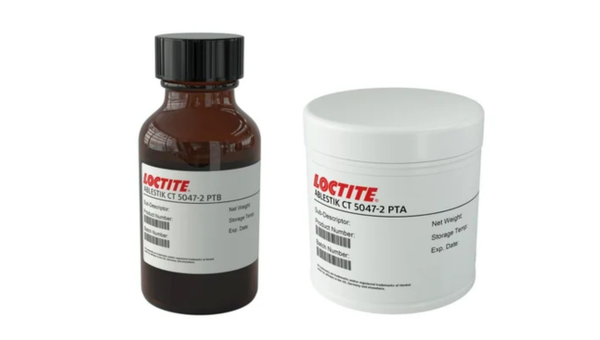
LOCTITE ABLESTIK CT 5047-2 is a silver, two-component epoxy adhesive for electrically conductive assembly bonding where hot soldering is impractical or where conductive plastics cannot be subjected to high temperatures. Component A and the amine hardener are mixed at 100:6 by weight, providing a typical one-hour work life at 25 degC. The adhesive can cure at room temperature or with heat, with optimum properties specified for cure at 65 degC or higher. It operates from -40 to +130 degC and provides cure-dependent electrical resistivity.
Key features
- Electrically conductive epoxy: Silver-filled two-component system for conductive assembly bonding.
- Room-temperature or heat cure: Guideline schedules include 24 hours at 25 degC, 2 hours at 65 degC, or 1 hour at 100 degC.
- Useful processing window: Typical one-hour work life at 25 degC for a 100 g mixed mass with documented good dispense behavior.
Applications / Suitable for
- Electrical connections where hot soldering is impractical
- Electrical connections to conductive plastics at temperature-sensitive locations
- General electrically conductive assembly bonding
TDS, SDS & Technical Documents
Technical Specifications
General Properties
Thermal Properties
Additional Information
LOCTITE ABLESTIK CT 5047-2
A silver, two-component epoxy adhesive designed to make electrical connections where hot soldering is impractical and to connect conductive plastics in temperature-sensitive locations. The system combines room-temperature or heat-cure processing, a typical one-hour work life at 25 degC, and cure-dependent volume resistivity for conductive assembly evaluation.
As-Supplied Properties
| Property | Value | Unit | Method / condition |
|---|---|---|---|
| Technology | Epoxy | Component A / system | |
| Part B technology | Amine | Component B | |
| Component A appearance | Silver paste | As supplied | |
| Component B appearance | Amber liquid | As supplied | |
| Component A density | 3.48 | g/cm3 | As supplied |
| Component B density | 1.06 | g/cm3 | As supplied |
| Mix ratio | 100 : 6 | Component A : Component B by weight | |
| Mixed density | 3.34 | g/cm3 | Mixed material |
| Work life | 1 | hour | 100 g mixed mass at 25 degC |
| Shelf life, Component A | 24 | months | 25 degC, from date of manufacture |
| Shelf life, Component B | 24 | months | 25 degC, from date of manufacture |
Processing and Cure
Clean substrates thoroughly to remove oxide layers, dust, moisture, salt, oils, and other contamination. Remix the resin container before measuring because filler settling during shipping and storage is normal. Accurately weigh resin and hardener at 100:6 by weight, then knead the components for 2 to 3 minutes while scraping the bottom and sides of the mixing container until the mixture is uniform.
The cure schedules are guideline recommendations. Actual conditions may vary with application requirements, cure equipment, oven loading, and actual oven temperature.Storage and Handling
Store the original, tightly covered containers in a clean, dry area at the stated optimal storage temperature of 25 degC. Component A and Component B each have a typical shelf life of 24 months at 25 degC from the date of manufacture. Do not return removed material to the original container because contamination may occur.
Cured Properties
| Property | Value | Unit | Method / condition |
|---|---|---|---|
| Hardness | 82 | Shore D | Cured material |
| Volume resistivity | 0.002 | ohm-cm | Cured 2 hours at 65 degC |
| Volume resistivity | 0.02 | ohm-cm | Cured 24 hours at 25 degC |
| Aluminum-to-aluminum tensile lap shear | 6.9 | N/mm2 | Tested at 25 degC; 1,000 psi |
| Operating-temperature range | -40 to +130 | degC | Documented product operating range |
The difference between the two reported resistivity values is cure-condition-specific evidence. It should not be converted into a universal contact-resistance or assembly-resistance claim.
Performance Evidence
The TDS reports outgassing results per NASA Reference Publication 1124 after a defined multi-step cure. These values apply to that tested preparation and should not be generalized to other cure histories, package geometries, or qualification programs without validation.
Total mass loss per NASA Reference Publication 1124.
Collected volatile condensable material result.
Cure sequence associated with the reported outgassing results.
Applications
The product is specifically positioned for electrically conductive assembly where soldering temperature is a constraint. Application suitability remains dependent on the actual conductive substrate, joint geometry, cure, and electrical-performance requirements.
Evaluate LOCTITE ABLESTIK CT 5047-2 for Your Conductive Assembly
Krayden can support evaluation of substrate cleaning, component mixing, work-life control, dispensing, cure-profile selection, conductive-plastic bonding, electrical resistivity, and low-outgassing requirements. Application trials should confirm performance for the intended materials, geometry, cure, and service environment.