ABLESTIK 9392
Harmonization Code : 3506.91.90.99 | Prepared glues and other prepared adhesives, not elsewhere specified or included; products suitable for use as glues or adhesives, put up for retail sale as glues or adhesives, not exceeding a net weight of 1 kg ; Adhesives based on polymers of headings 3901 to 3913 or on rubber; Other ; Other
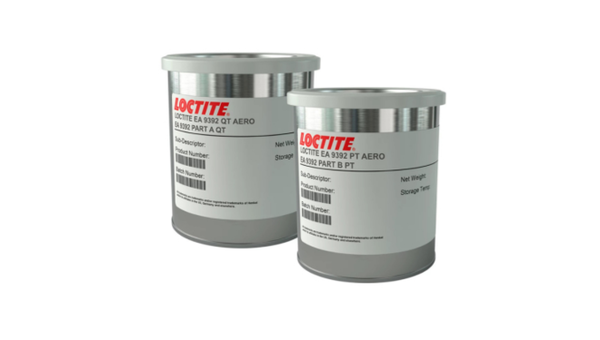
Main features
- Flexible Cured Adhesive
- 168-Hour 24 deg C Cure
- 1.00 x 10^13 ohm-cm Volume Resistivity
Product Description
LOCTITE ABLESTIK 9392 is a clear amber, two-component epoxy encapsulant designed for general potting applications. The mixed material has a typical viscosity of 17,000 mPa.s (cP) and a specific gravity of 1.0. It can be cured at room temperature or with heat, using guideline schedules of 168 hours at 24 degC or 16 hours at 82 degC. The cured material is flexible and provides documented electrical insulation, shear strength, and tensile strength.
Key Features
- Two-component epoxy encapsulant for general potting applications
- Clear amber appearance
- Room-temperature or heat-cure capability
- Typical mixed viscosity of 17,000 mPa.s (cP)
- Flexible cured material with Shore A hardness of 60
- Typical cured volume resistivity of 1.00 x 10^13 ohm-cm at 25 degC
Applications / Suitable for
- General potting and encapsulation
- Assemblies involving metals, wood, many plastics, and rubber
- Applications requiring a flexible cured epoxy encapsulant
- Potting applications requiring room-temperature cure capability
TDS, SDS & Technical Documents
Technical Specifications
General Properties
Electrical Properties
Additional Information
Two-Component Epoxy Encapsulant
LOCTITE ABLESTIK 9392
LOCTITE ABLESTIK 9392 is a clear amber, two-component epoxy encapsulant for general potting applications. The system combines a typical mixed viscosity of 17,000 mPa.s (cP) with room-temperature or heat-cure capability and a flexible cured state. Documented substrate classes include metals, wood, many plastics, and rubber.
Mixed Material
As-Supplied Properties
The available technical data provide mixed-material properties rather than separate component viscosities or densities. These values should therefore be interpreted as applying after the two components are thoroughly combined.
| Property | Typical value | State / context |
|---|---|---|
| Technology | Epoxy | Two-component system |
| Appearance | Clear amber | As supplied / mixed system |
| Mixed viscosity | 17,000 mPa.s (cP) | Mixed uncured material |
| Specific gravity | 1.0 | Mixed uncured material |
Preparation, Mixing and Cure
Processing and Cure
Clean and dry all surfaces before application. Thoroughly mix both components until the color is uniform throughout, then apply the fully mixed material to the prepared surfaces or potting area. Where the material is used as an adhesive, gently press the joined surfaces together and maintain contact until cure is complete.
The cure profiles are guideline recommendations. Actual cure conditions can vary with the application, curing equipment, oven loading, and actual material temperature.
Storage and Handling
The technical data sheet identifies optimal storage at 27 degC or below in the unopened container and a dry location. The supplied U.S. safety data sheet provides a more conservative safety-storage instruction of -40 degC or below. Because these documents differ materially, the publication page should not present a single storage condition as definitive until the applicable current regional storage requirement is confirmed.
Final Cured Material
Cured Properties
The values below are typical laboratory data for the cured material or bonded specimens. Preserve the stated frequency, temperature, and substrate when using these values for product evaluation.
Typical cured physical property.
Typical cured value at 25 degC.
Typical value, equivalent to 1,000 psi.
| Property | Typical result | Condition / context |
|---|---|---|
| Hardness | 60 Shore A | Cured material |
| Dielectric constant | 7.0 | 1 kHz |
| Dielectric constant | 4.3 | 1 MHz |
| Volume resistivity | 1.00 x 10^13 ohm-cm | 25 degC |
| Lap shear strength | 4.14 N/mm2 (600 psi) | Glass substrate |
| Tensile strength | 6.89 N/mm2 (1,000 psi) | Cured material |
Documented Use Scope
Applications
General Potting
Designed for general encapsulation and potting where a two-component epoxy system and flexible cured state are appropriate.
Mixed-Material Assemblies
Documented substrate classes include metals, wood, many plastics, and rubber. Suitability remains dependent on the exact grade, surface condition, preparation, and application design.
Flexible Encapsulation
The cured Shore A hardness of 60 supports evaluation where a flexible epoxy encapsulant is preferred over a rigid cured material.
Technical Support for LOCTITE ABLESTIK 9392
Discuss material conditioning, mixing, potting geometry, cure selection, substrate preparation, and electrical or mechanical evaluation requirements with Krayden. Application trials should confirm the material's behavior in the intended assembly, process, section thickness, and service environment.
Contact Krayden Technical Support